Content: Section 1: Concept. Section 2: Introduction & Historical Context. Section 3: Post-Independence Developments in African art. Section 4: Creation of international avenues. Section 5: Market positioning and Artist. development Section 6: Use of digital and online Market places. Section 7: Participation in Art fairs and Biennials by African artists. Section 8: Conclusion. Section 9: List of image sources and Bibliography.
Section 1: CONCEPT
The African art market represents one of the most dynamic and rapidly evolving segments of the global art world, yet it remains understudied within academic design and art market research. Record-breaking auctions at Sotheby’s and Christie’s, the prominence of African artists at major biennials like Venice Biennale in Italy, Whitney Biennial in the United States of America, São Paulo Biennial in Brazil, Gwangju Biennale in South Korea, and the proliferation of art fairs such as 1-54 Contemporary African Art Fair, Afriart Gallery based in Uganda, Gallery 1957 and Art X Lagos, signal a significant shift.
This research seeks to move from observing this phenomenon to analyzing the deliberate strategies that underpin it. Moving beyond a simplistic narrative of «discovery,» it posits that the rising global prominence of African art is the result of deliberate, complex, and often contested strategies arranged by a network of actors including artists, galleries, curators, auction houses, and art fairs.
Carrying out a visual research on this topic provides crucial insights into how cultural production from historically marginalized regions navigates global commercial systems. The strategies employed by African artists, galleries, and institutions offer valuable case studies in market creation, cultural entrepreneurship, and the negotiation between regional authenticity and global commercial demands. The visual research question is: How African artists, galleries, and institutions developing strategic approaches to establish sustainable presence and value within the international art market? The research hypothesis is: African art’s increasing prominence in international markets results from a coordinated ecosystem of specialized fairs, diaspora engagement, strategic curation, digital innovation, and regional hub development-rather than isolated individual successes-representing an emergent model for global South cultural production within global creative industries.
Visual materials were selected to represent regional diversity, multiple generations of artistic practice, and varied market success levels from emerging to established blue-chip artists. The presentation progresses thematically from historical context to current market structures, then to specific mechanisms and case studies, concluding with implications for designers. This organization reveals how historical patterns inform contemporary strategies while allowing clear sectioning for visual demonstration.
Section 2: Introduction and Historical Context
«View of the exhibition Seven Stories about Modern Art in Africa, the Senegalese story, at Whitechapel Gallery London, 1995.» Clémentine Deliss.
According to David Cecil (2014): In 1996, Olabisi Silva, the Nigerian curator and critic, wrote a review of africa95 stating that John Povey, former editor of African art, at the ACASA Triennial of 1989 asked: «What are we going to do about contemporary African art?» It seemed like a strange and bewildering question, which had triggered concern about accessibility and knowledge. A network of artists in African cities like Dakar and Johannesburg, with the support of London-based galleries, museums and collectors, made the multi-site exhibition africa95 possible. However, its focus on a constellation of art schools on the African continent such as Zaria, Makerere, Khartoum, and Addis was as revelatory as it was controversial. The exhibition also provoked serious questions about repatriation and colonialism. Olabisi Silva, in her review in Nka, used the term «cultural terrorism» to describe the inclusion of artefacts from an 1897 pillage of the Royal Palace of Benin.
Market Day by Sam Nitro (1953)
African culture was seen as closer to the beginnings of civilization and thus naïve and pure, undeveloped and unspoiled. Kandinsky viewed ‘the primitive mentality’ as allowing access to ‘interior truths’ that were obscured by the corrupt materialism of modern life. This reflects a common view of traditional African artists as unconsciously channeling a genius that could be perceived by Western connoisseurs, and rarely imitated by trained artists.
Margaret Trowell, 1946, Uganda Society Archive.
It is clearly articulated that Magaret Trowell’s quest to seek out the true ‘Africanness’ in her students was not so peculiar for an expatriate European artist on the continent; it was merely ahead of its time. Workshops instituted and conducted by European mavericks and eccentrics began to spring up in Nigeria, Belgian Congo, South Rhodesia and elsewhere in Africa between the Second World .War and Independence. David C (2014).
Peter K. Mulindwa, Untitled, 1981, Oil on Board, 119,5 cm x 195 cm. Makerere Art Gallery collection.
It is important to note that the africa95 platform was supported by international structures that made their local and international networks available to the curators. These included at an early stage, Robert Loder’s Triangle Workshops, which mostly had taken place in Southern Africa.
«Africa95 festival, Africa: Art of a Continent exhibition at Royal Academy of Arts. Design of the exhibition cases with Eva Jiricna Architects, London 1995.» Aivars Architects Ltd
The conception of «contemporary African art» in the context of africa95 was negotiated through platforms such as the 1991 SOAS African artist seminars, Tenq and the Dak’art Biennale of Contemporary Art in 1992. The support of knowledge and funding networks, and larger interconnections between artists in Dakar and London subsequently shaped africa95. In London, galleries (Whitechapel, Barbican Art Center), museums, universities (Royal Academy of Arts, School of Oriental and African Studies), culture offices (Arts Council England), and diplomatic missions (British Council and European Development Fund) were all involved in the realization of the africa95 platform. The support of diplomatic and government institutions also heavily shaped the platform, providing a layer of cultural diplomacy and negotiating within the field of international contemporary art. David C (2014).
Section 3: Post-independence developments in African art
Works of some African internationally recognized artists
Post-independence developments in African art have seen rapid growth on the international market, this is due to the increasing recognition of African artists from modernism through the contemporary era. However, growth is not just automatic, it is accelerated by major auction houses and galleries, art fairs such as Art x in Lagos. The expansion of collector base both within and outside Africa is also another factor for this rapid growth.
Okwui Enwezor. Photo: Andreas Gebert, 2011, Courtesy Museum Folkwang.
A key turning point started with Nigerian curator Okwui Enwezor, who made history directing Documenta 11 in 2002 the first truly postcolonial edition of the seminal German art show. His Short Century exhibition (2001) tracked Africa’s liberation movements through art, while Snap Judgments (2006) spotlighted contemporary African photography. Enwezor redefined global curatorial practice and expanded the space for African artistic discourse on its own terms. The inaugural Dak’Art Biennale in 1996 became a crucial platform dedicated exclusively to contemporary African art.
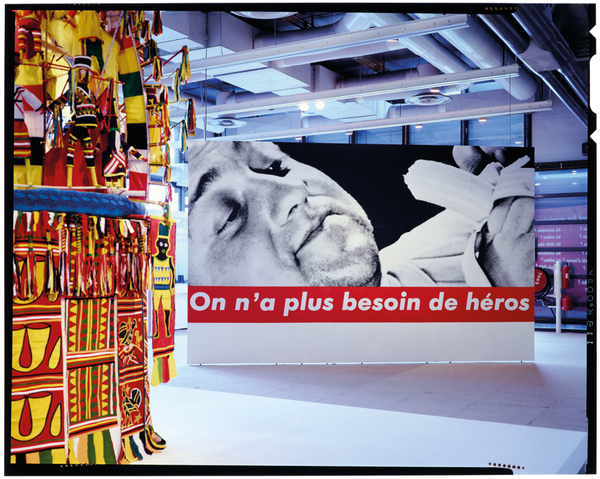
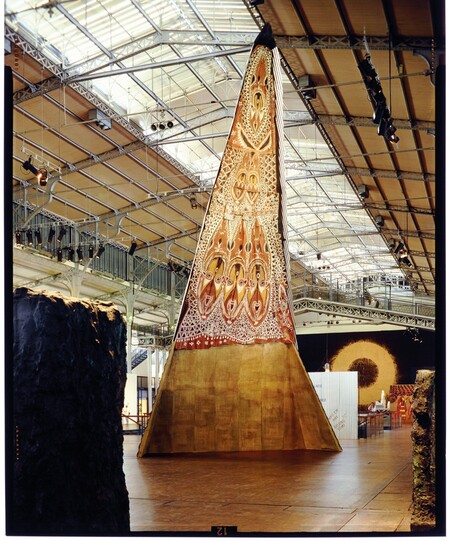
Mike Chukwukelu, 1989 and Barbara Kruger, We Don’t Need another Hero, 1989. (L) Nera Jambruk, Papua New Guinea, 1988®, installation view, ‘Magiciens de la terre’, Paris, 1989.
Lisa Mathews, (2025) articulates that: «The late 20th century saw a shift in how African art was exhibited and discussed. Landmark exhibitions such as Magicians de la Terre (Centre Pompidou, 1989) and Primitivism in 20th-Century Art at MoMA began including African artists in international contexts, though often under problematic framings. African publications like Revue Noire and Africa’s Journal challenged these perspectives, centering African voices and artistic agency.»
In the process of striving for the international market, post-independence artists decided to engage in a critical redefinition of form and identity, blending indigenous aesthetics with international modernist movements. The good examples of some movements that emerged are: Poto-Poto (Congo-Brazzaville), and École de Dakar (Senegal). Contemporary artists are exploring African narratives and identities, through mixing traditional and contemporary elements in their art works.
Section 4: Creation of international avenues
«African Art Investment: Emerging Markets and Cultural Significance» MoMAA, 2025.
African art has gone an extra mile to establish spaces in global art hubs, representing artists from the global south to build international networks as well as fostering cross-diasporic conversations. This is driven by major exhibitions, digital platforms, and a growing global appreciation for Africa’s diverse creative expressions.
According to MoMAA, (2025). East African markets including Uganda, Kenya, Tanzania and Ethiopia, show emerging potential with developing gallery scenes and increasing international attention from collectors and institutions. Nairobi’s contemporary art scene demonstrates particular growth with established galleries and art fair participation that creates market visibility and career opportunities for local artists. Nigerian contemporary art depicts a particular strength with artists like Njideka Akunyili Crosby, Yinka Shonibare and Ben Enwonwu achieving significant international recognition and market success. The Lagos art scene benefits from economic growth and cultural investment that creates sustainable market infrastructure for long-term growth and artistic development. Ghanaian art markets demonstrate strong cultural traditions combined with contemporary innovation, with artists like El Anatsui achieving major international recognition while maintaining connections to traditional artistic practices. Accra’s gallery scene shows growing sophistication with international programming and collector development that supports market growth.
Section 5: Market positioning and Artist development
Portraits and artworks of some iconic African artists who have internationally positioned themselves on the art market.
Camille H. (2023) asserts that:
«…we have seen a marked increase in interest in African modernism, referring to the work of artists primarily active from the post-independence era through the 1980s. These artists, working across painting, sculpture, printmaking, and beyond, often engaged in a critical redefinition of form and identity, drawing from both indigenous aesthetics and international modernist movements. Despite their significance, many of them have remained underrepresented in major institutions and the global art market.»
Majority of African artists are fighting tooth and nail to produce art works that can be recognized internationally, Despite of the unique international techniques and styles used in their art works, majority of them are still unrecognized on the international art market, however this has not stopped from producing creative and unique art works. There are some African artists who have gone an extra mile and this is depicted by the increasing demand for there artworks on the international art market.