Multimedia Quest: The History of the Chekhov Moscow Art Theatre The theater is once again searching for the Blue Bird and calls upon the city for help. But its voice has long since dissolved into the everyday noise. Eight characters from the play «The Blue Bird» come to life in locations linked to the history of the Moscow Art Theatre, becoming guides into a hidden theatrical world. Each character reveals one of the components of theater to the participant and recounts the history of the location. The play’s characters appear where they felt something was missing. For instance, water paused near the Musical Theatre, finding harmony and calm within the flow of sound. Fire appeared near K. S. Stanislavsky’s house, where it found direction for its energy. The theater, too, feels something is lacking and invites the participant to join the search. Each character will tell the participant what became their Blue Bird and provide a clue about what the theater is seeking. By responding to the city’s call, the participant learns to notice more: the architectural details they observe while searching for figurines, and the elements of the stage world described by the characters. By gathering the characters’ testimonials, they understand who the theater is truly looking for. The theater’s Blue Bird is the audience member—the one who responds to the theater’s call and transforms the stage world into an experienced reality through their gaze.
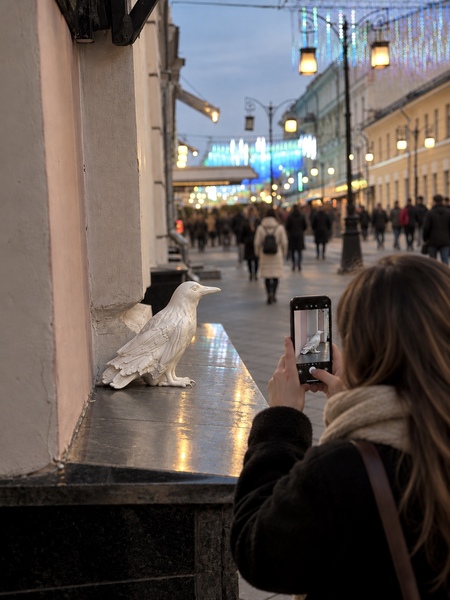
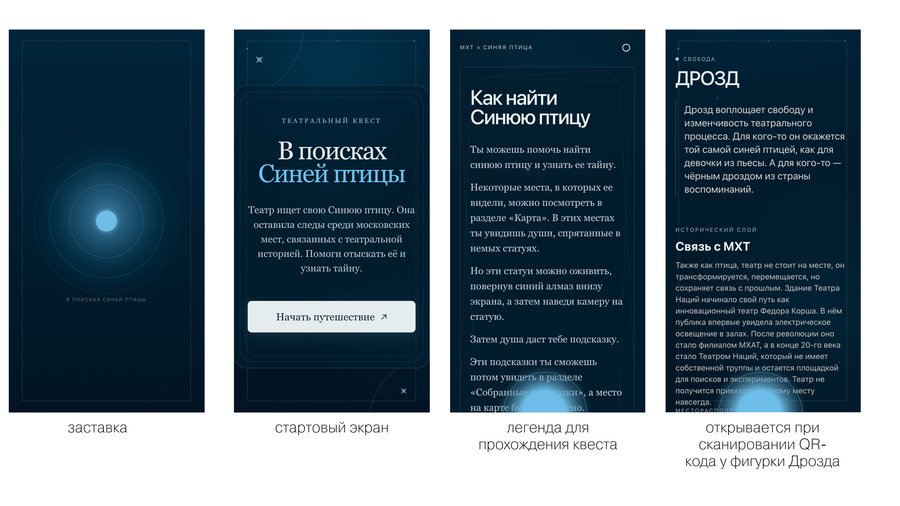
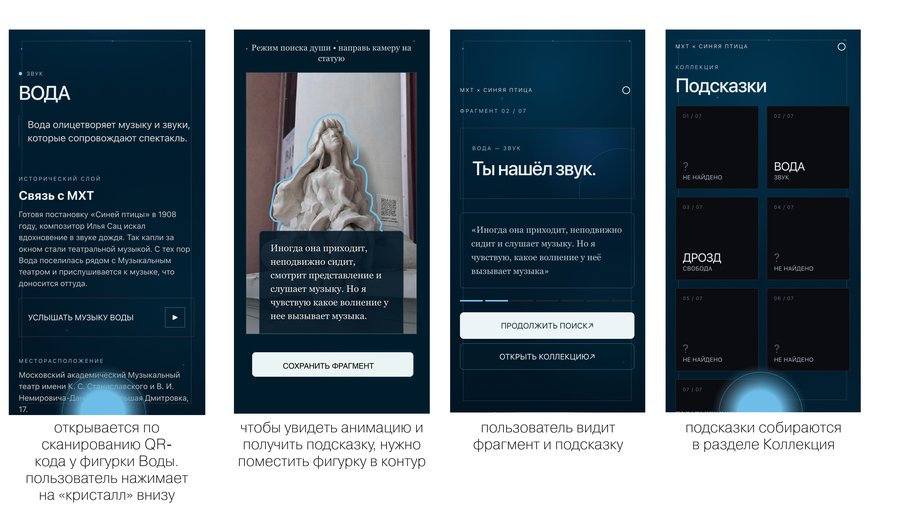
Each character, except for one, «remembers» their encounter with the Blue Bird and is ready to tell the story. In the play Metelinka, to hear the souls of objects, one had to turn a magical diamond. In this journey, the smartphone camera will serve as the diamond. The participant points the camera at the QR code—landing on the quest website where they can read the introductory text and proceed to scan the figurine. Using AR and animation, the figurine «comes to life.» After collecting the characters’ testimonies, the participant can understand to whom the theatrical world is addressed. The route is non-linear: any passerby who spots the figurine can become a participant and immediately begin their adventure.
By listening to the characters' stories, the participant gradually uncovers the various ways that theater creates a stage world. Tiltil and Mitil reveal the essence and components of the world surrounding them. The kids had not seen the beauty or value in everyday objects. The animated souls of objects and beings were able to show them the depth of the world around them. The audience member who comes to the theater is like a child looking at the world with wide-open eyes, yet unable to truly see. In our quest version, the play’s characters help participants perceive the different elements of theater, so that viewers learn to look deeper and see more. Answering the city’s call, the participant learns to notice more: the architectural details they examine while searching for figurines; the components of the stage world that the characters describe.
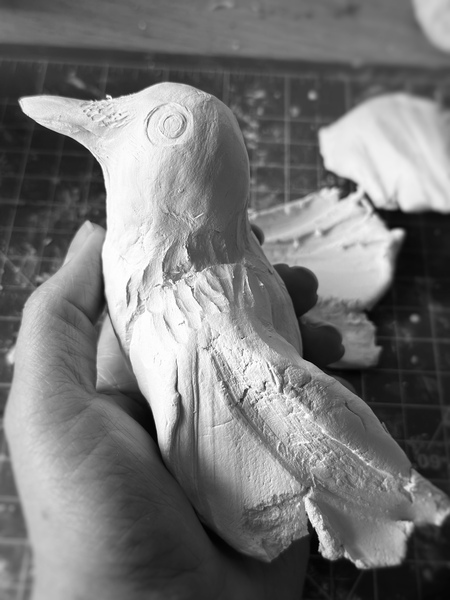
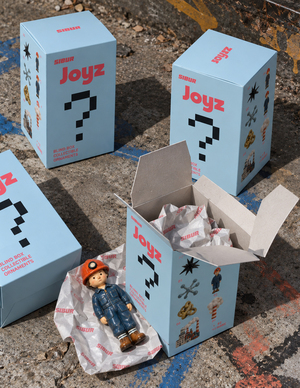
Figurines, approximately 20 cm tall, will be crafted from clay coated with waterproof glaze. Clay allows for the retention of the hand-made quality, intentional ambiguity, and organic imperfections in the form. These figurines exist in a space between a recognizable human figure and an abstract entity—much like the characters in «The Blue Bird.»
Clay is a material susceptible to rapid changes influenced by its environment—chips and cracks appear—allowing the figurine to live and evolve alongside the city.
The figurine prototypes were hand-sculpted using polymer self-hardening clay and refined with the assistance of Gemini AI.
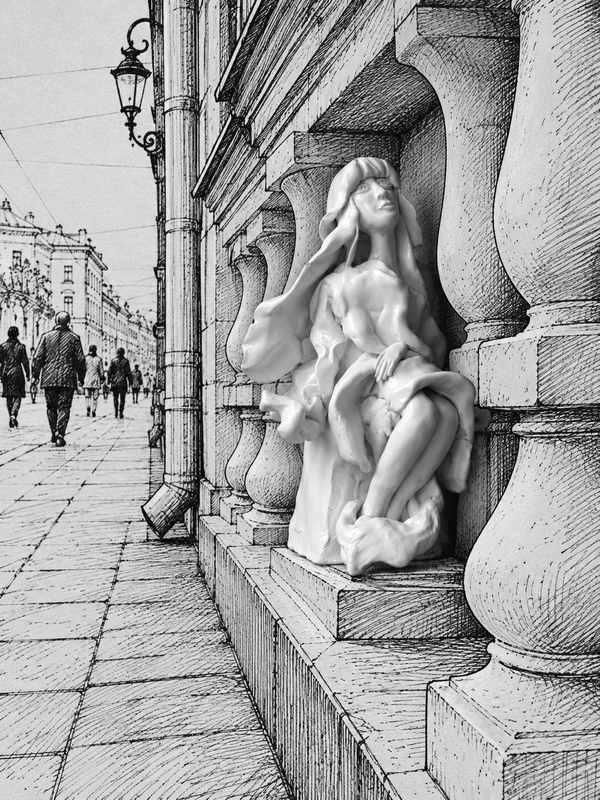
To demonstrate the visual language of the series, three figures were created: Fire, Water, and Blackbird. The full version of the route will feature eight figures. Each figure has its own plastic principle that reflects the character’s essence. For example, water is fluid, streamlined, and tranquil, while fire is directed upward and sharp.
Composing the piece «The Blue Bird» in 1908, composer Ilya Sats sought inspiration in the sound of rain. Thus, the raindrops outside the window became theatrical music.
Since then, Water has settled near the Music Theater and listens to the melodies drifting from there.
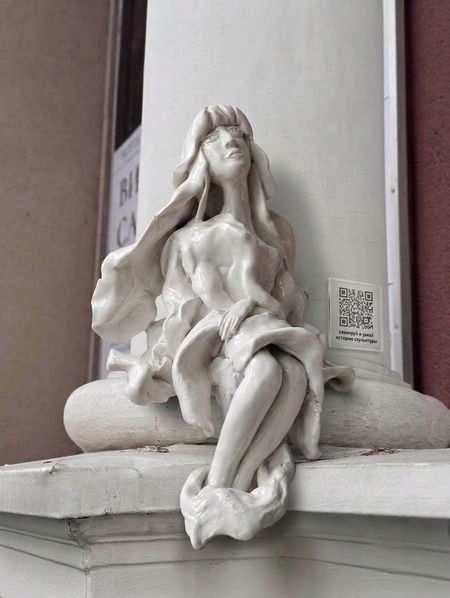
Location: Maxim Stanislavski and Vladimir Nemirovich-Danchenko Moscow Academic Theatre, Bolshaya Dmitrovka, 17.Hint: «Sometimes she comes, sits still, and listens to music. But I feel the excitement the music evokes in her.»
The figurines are placed on the facades of the buildings and are not always easy to spot. Please look at the column to the left of the entrance.
Spirit of Fire
At first glance, this mansion appears to be a typical 19th-century Moscow house. But upon venturing into the courtyard, its much older history is revealed: brick palaces from the 17th century, antique window casings, and ornate cornices. Behind the classical facade lies a building that has evolved with the ages. In the 20th century, its rooms found a new purpose—in 1921, Konstantin Stanislavski moved into the house on Leontievsky Lane.
He was searching for a space for the Opera Studio he directed. Stanislavski aimed to transfer the principles of psychologically truthful acting to operatic art. He believed that an opera singer needed more than just a powerful voice and musicality; they had to understand their character, act within the given circumstances, and convey emotions through their voice, movement, and stage presence. In the Opera Studio, singers mastered acting skills, while the director sought ways to make their stage life feel more natural and compelling.
The house’s greatest asset turned out to be the Onegin Hall—a former ballroom with columns, high ceilings, and excellent acoustics. This space could accommodate the orchestra and later became a stage. He sought an environment where he could work on voice, music, movement, and dramatic action—and he found it. The house merged private life with a theatrical laboratory. Stanislavski occupied the second floor: four rooms served as living quarters, and three were dedicated to the Opera Studio. It was not a separate institution where he came for classes, but a space where daily life coexisted with rehearsal work.
Stanislavski looked for methods that would help an artist move beyond waiting for a random flash of inspiration and instead consistently find a path to genuine experience. Gradually, his system took shape. The artist learned to work with imagination, focus, and the given circumstances; to find the super-objective—the main goal of the character—and the through-line action that linked all their actions into a cohesive narrative. Inspiration remained important, but it was no longer the sole hope of the actor. Techniques emerged that helped actors rediscover the path to organic experience.
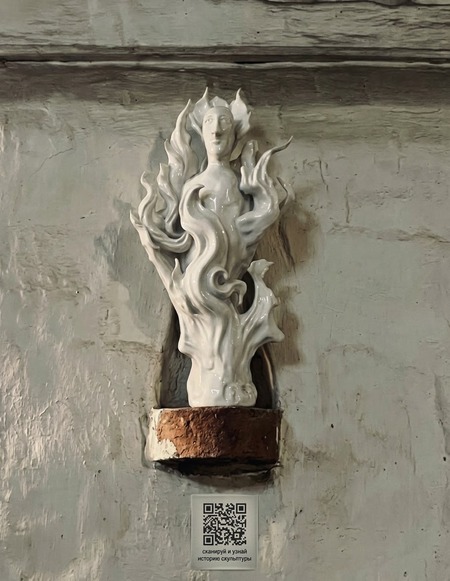
Location: K.S. Stanislavsky Museum-House, Leontyevsky Pereulok, bldg. 6, str. 1.Hint: «In the early evening, she is so cold and quiet, but then hundreds of her small inner flames flare up.»
Black Thrush
For some, it will be that very bluebird, like in the girl’s play. For others, it will be a black thrush from a country of memories. Like a bird, the theater does not remain static—it transforms and moves, yet it maintains a connection to the past. The National Theater building began its journey as Fedor Korsh’s innovative theater. It was there that the public first saw electric lighting in the halls. After the Revolution, it became a branch of the Moscow Art Theatre, and by the late 20th century, it became the National Theater, which does not have its own permanent troupe and remains a venue for searching and experimentation. A theater cannot be permanently tied to one place.
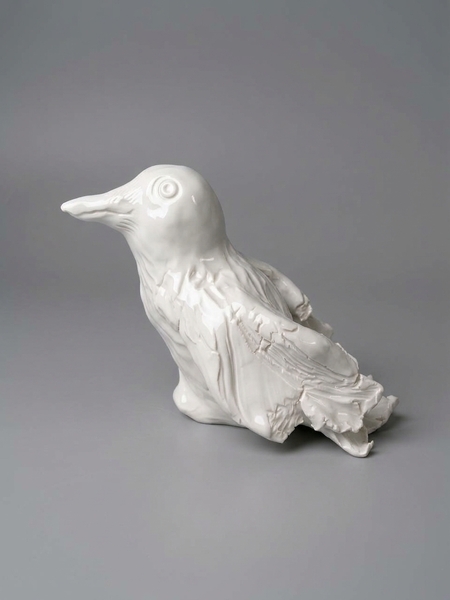
Location: National Theatre building, Petrovsky Pereulok, 3Hint: «I am not the blue bird you are looking for. But it used to appear here, and every theater had its own.»
Digital Layer
Website adapted for smartphone use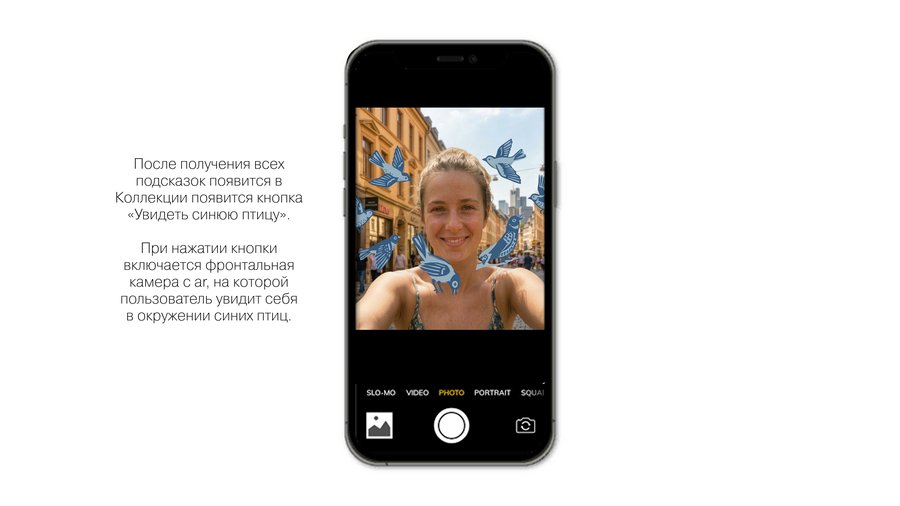
The blue bird of theater is the audience member who responds to the call of the theater and transforms the stage world into internal experiences with their gaze.
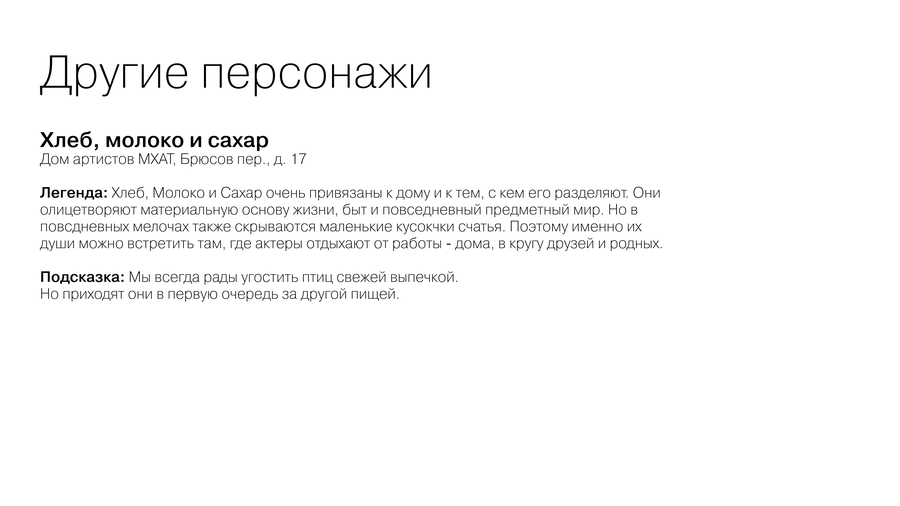
Character Descriptions Not Included in the Visualization
Search form