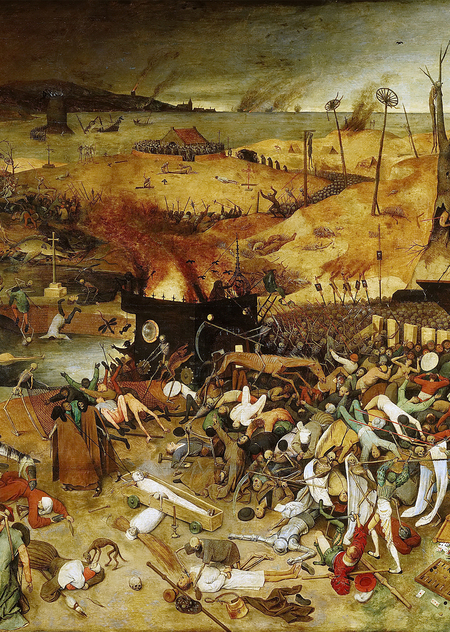
Introduction

The Dance of Death (1463, Bent Nutke)
The fear of an epidemic is not just a natural human reaction to the threat of illness and death; it is a complex cultural phenomenon that impacts the structure of society, political relations, perceptions of safety, and the boundaries of human existence. Throughout history, epidemics have been sources not only of physical suffering but also of social upheaval—they have altered daily habits, spurred the search for scapegoats, intensified mistrust among people, and forced a reevaluation of the normal order of life.
Unlike a war or natural disaster, an infectious threat is invisible. Humans cannot always determine who is carrying the illness, where the source of infection is, or how great the danger is. Therefore, an epidemic shatters the familiar sense of control over surrounding reality—the potential threat can hide anywhere.
The goal of this research is to examine the fear of epidemics as a cultural phenomenon, identify its core mechanisms, and analyze how the threat of an epidemic impacts social relations, political institutions, and a person’s perception of their own body and the surrounding world.
1. Disruption of established social order
An epidemic is not only a threat to human health but also a serious test for society. The illness of one person can affect many others, so a private issue quickly becomes a public one.Eugene Thacker connects three concepts: nomos—social order, nosos—disease, and bios—life. Their connection shows that an epidemic affects not only the human body but also the established way of life of society. [1]
During a pandemic, people’s daily behaviors change. Routine activities—such as shaking hands, riding public transport, or meeting friends—begin to be perceived as potential threats.
The COVID-19 pandemic is a prime example: people started wearing masks, maintaining distance, visiting public places less frequently, and working from home. The home began to be viewed as a safer place, while public spaces were seen as a possible source of infection.
Thus, the epidemic alters the established order of life and blurs the line between personal and public safety. The health of one individual becomes significant for the entire community.
2. The Invisible Threat and the Formation of Collective Fear
One of the main reasons people fear epidemics is the invisibility of the virus. An individual cannot assess the danger on their own: a person who appears healthy can also be a carrier of infection. Consequently, it becomes difficult to pinpoint the exact source of the threat.
Unlike the fear of a specific enemy, the fear of contagion has no clear boundaries. One can contract it in various places and from different people. Because of this, the danger begins to seem ubiquitous. People become more cautious: they avoid unnecessary contact, monitor their health, and try to notice possible signs of illness. Even a casual touch or close conversation can cause anxiety.
«Doctor Schnabel von Rom» (1656, Paul Fürst)
This became especially noticeable during the COVID-19 pandemic. Masks, antiseptics, temperature checks, and social distancing became part of daily life. Yet, the absence of symptoms no longer guaranteed that a person was uninfected.
Thus, the fear of an epidemic is tied not only to the disease itself but also to uncertainty. People fear what they cannot see or fully control.
3. Illness as a Political Category: Biopolitics and Control
The epidemic becomes not only a medical but also a political issue. Eugene Thacker points out that the fight against diseases is increasingly tied to questions of public safety. The state begins to perceive the spread of infection as a threat that requires specific control measures.
To understand this process, the concept of biopolitics is essential—the management of population life and health. During an epidemic, it manifests through quarantines, movement restrictions, mass testing, and monitoring the spread of infection.
Tucker also emphasizes the convergence of epidemiological surveillance and national security measures. Natural infectious diseases and artificially created biological threats can be viewed as parts of a single control system. For example, the digital systems that emerged during the COVID-19 pandemic—QR codes, vaccination certificates, and contact tracing applications—helped regulate people’s movement and access to public spaces.
Here arises a contradiction: while state control can help protect public health, it simultaneously restricts personal freedom and privacy.
The fear of an epidemic can become a catalyst for increased state control. This raises the question of where the boundary lies between societal security and individual freedom.
4. The Depiction of Contagion and the Search for the Culprit
During epidemics, society often tries to find someone to blame for the spread of the disease. When the causes of what is happening are unclear, it is easier for people to link the danger to a specific individual or group. As a result, the infected person may be perceived not simply as a sick individual needing help, but as a source of threat. This leads to isolation, condemnation, and discrimination.
«The Burning of Jews During the Plague» (1349–1352, Gilles Le Moyeux)
Such attitudes were evident even during the plague epidemics in Europe. Due to a lack of medical knowledge, people blamed specific population groups for spreading the disease. Such accusations often led to persecution and violence.A similar situation was observed during the COVID-19 pandemic: sick individuals could be avoided, and certain national groups faced accusations and discrimination.
Thus, the fear of an epidemic can intensify pre-existing prejudices. When a society does not understand the causes of danger, it attempts to find a culprit, and the infected person becomes a symbol of that threat.
5. The Image of Epidemic in Contemporary Mass Culture
In contemporary mass culture, the epidemic is not merely a narrative about the spread of disease. It has become a symbol of an invisible threat, the dissolution of the familiar world, and a test of human nature. Through stories of infection, society speaks to the fear of the unknown, mistrust of others, crises of power, social isolation, and the boundaries of the human condition.
5.1. Apocalyptic Image
One of the most common depictions of an epidemic in mass culture is the end of civilization. Here, the illness acts not merely as a cause of mass mortality, but as a force that dismantles daily life: transportation grinds to a halt, cities are sealed off, familiar social institutions vanish, communications break down, and the state loses control over its territory.The epidemic becomes a distinct threshold between two worlds—the old, organized, and predictable world, and the new, where survival supersedes law, morality, and civic obligations.


«28 Days Later» (Danny Boyle, 2002) // «The Last of Us» (Naughty Dog, 2013)