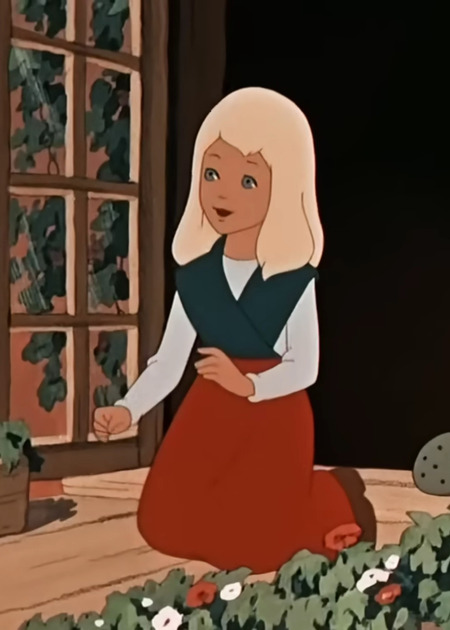
Concept
In the late 1940s and 1950s, Soviet animation dramatically shifted its direction. Soyuzmultfilm moved away from the early avant-garde explorations of the 1920s, as well as from the American comedic style of Disney. The studio focused on feature-length fairy tale films. The primary technique employed became the «éclair» method. This domestic form of rotoscoping involved pre-filming live actors onto film stock, which were then redrawn frame-by-frame.
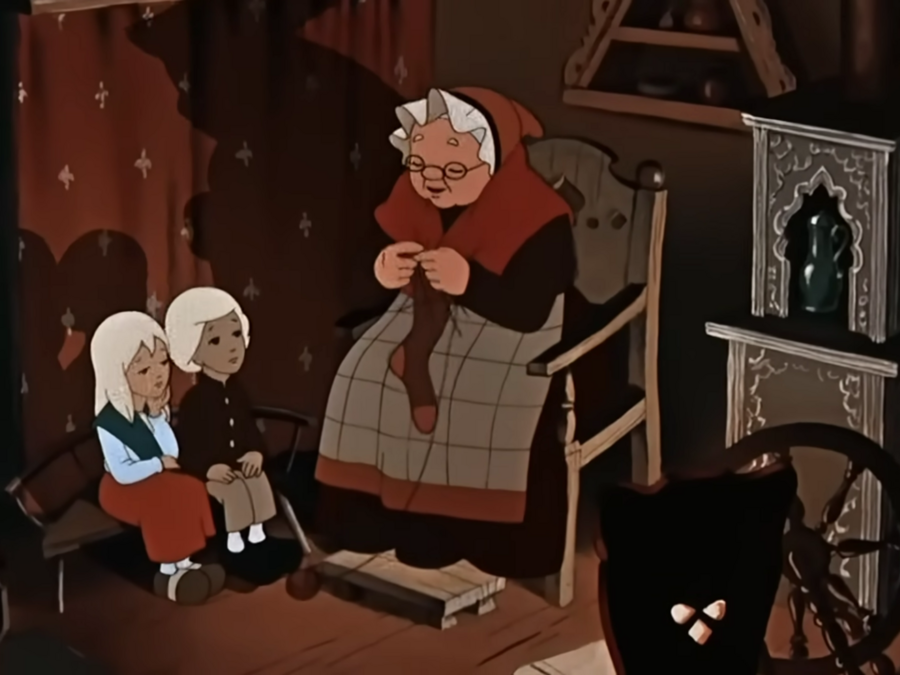
«The Snow Queen» (1957)
Often, film history portrays «the eclair» as a forced measure—as if artists were compelled by the rigid constraints of Socialist Realism to merely outline film frames for the sake of superficial verisimilitude. However, a closer examination of cartoons from that period reveals that this was not mechanical imitation of reality, but rather an independent artistic school. Soviet animators managed to synthesize rotoscoping technology with the traditions of book illustration, classical ballet, and Russian psychological theater.
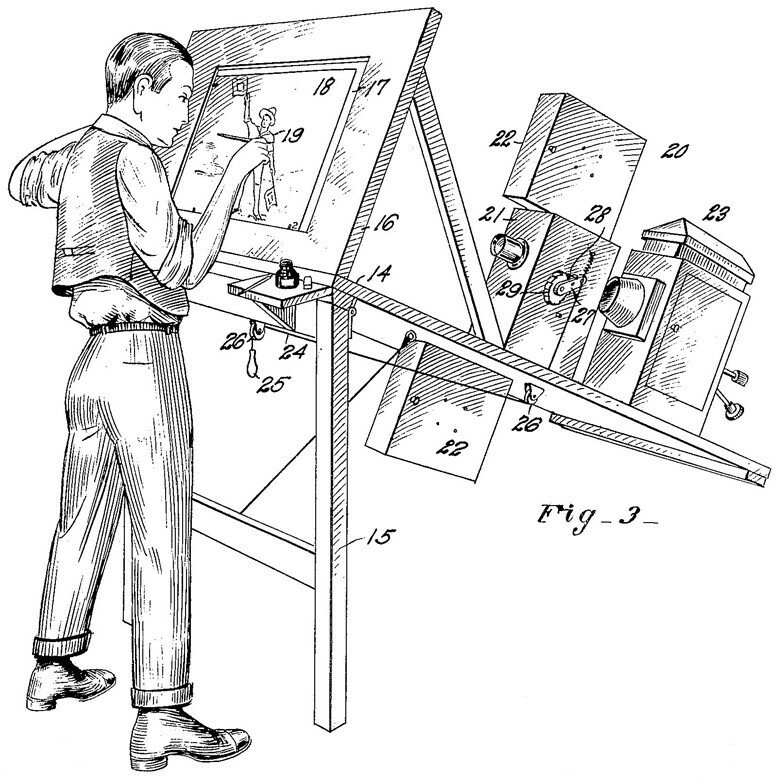
Eclair
For these live location shoots, we invited distinguished professionals: leading actors from the Moscow Art Theatre and the Vakhtangov Theatre—Zheima Yanina, Alexey Gribov, Maria Tabanova, and Lev Sverdlin. The actors didn’t just pose for the camera; they performed their full roles in costume, creating character, movement logic, and rhythm. The artists took this acting foundation but didn’t blindly transfer it onto paper. They filtered out the mundane clutter, highlighted the essential elements, and made the gestures expressive and fluid. Despite this approach, the characters integrated seamlessly with the stylized and painterly backdrops of the fairy tales.
The central hypothesis of this study is that the Soviet «eclair» in various fairy tales from 1947–1957 was not merely a technical embellishment for realism, but an independent artistic language. Primarily, due to the synthesis of Mikhalkov’s acting style, balletic expressive dynamism, and graphic stylization, the artists created a unique, singular type of character—one that was vibrant and organically integrated into the fairy tale world.
The goal of this work is to investigate how live-action footage of actors was transformed into expressive animation, using classic Soyuzmultfilm cartoons as examples («The Scarlet Flower, ” „The Golden Antelope, ” and „The Snow Queen“). Key objectives of the research include:
- Examining how the work with live material and the actors' performance was structured in the creation of realistic characters.
- Observing how theatrical expressiveness—gestures, gait, and facial expressions—was transferred into animated scenes.
- Analyzing the techniques used to convey complex motion dynamics—jumping, running, and balletic fluidity.
- Conducting an analysis of how artists rendered the weight and movement of intricate fabrics, as well as how they integrated characters with fairytale backdrops.
This study is based on an analysis of visual film frames, frame-by-frame dissection of the plasticity of gestures, costumes, and movements, and a comparison of individual live photographs with the animation scenes.
Pavilion and Film: On-Site Documentation of Acting Performance
Character development began not at the animator’s desk, but on the sound stage. Directors worked with the artists like they did in live-action filmmaking: setting up lighting, selecting props, and blocking scenes. On-set photographs and production stills demonstrate how deeply the actors inhabited their roles in front of the camera and how accurately the designers captured the hero’s character.
«The Snow Queen, ” 1957. Gerda—Yanna Zhaymo.
«Snow Queen, ” 1957. Queen: Maria Babanova.
Artists were filmed on 35 mm film without heavy makeup to preserve natural facial expressions, and the footage was projected onto the animator’s table via a special «Eclair» machine.
From MKhAT to Celluloid: Transferring Stage Gesture and Mime
The psychological school of Russian theater introduced an attention to the character’s inner state in Soviet animation. In the example of «The Scarlet Flower, ” it is clearly evident how restrained the bows are, how expressive the turns of the head are, and even the movement of the hands. All of this harmoniously integrates into the fairy tale world.
«The Scarlet Flower» (1952)
Artists stripped away superfluous daily clutter, leaving behind precise, meaning-laden stage gestures.
«The Scarlet Flower» (1952)
In the animated film «The Scarlet Flower, ” Lev Atamanov constructed scenes around the audience’s psychological pauses. The merchant’s character, portrayed by Alexey Gribov, was conveyed through a restrained posture, gaze, and facial expression.
«The Scarlet Flower» (1952)
«The Scarlet Flower» (1952)
«The Scarlet Flower» (1952)
Ballet Organics: The Dynamics of Steps, Jumps, and Running
In scenes of particular complexity and dynamism, «Eclair» relied on the laws of classical choreography. For instance, in «The Golden Antelope,» the expressive and lively run of the boy, as well as the jumps of the antelope itself, are structured according to the principles of ballet dance—featuring the fixation of extreme points of motion and smooth transitions between them. The sharp and impulsive plasticity of the greedy Raji’s movements is subjected to a strict internal rhythm.
«Golden Antelope» (1954)
The «Golden Antelope» jumps featured performers from the Bolshoi Ballet, which added expressive quality to the movements. Additionally, during the redraw, the animators held the character at the apex of the jump for a couple of extra frames.
«Golden Antelope» (1954)
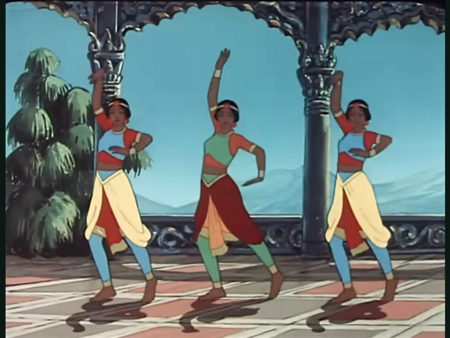
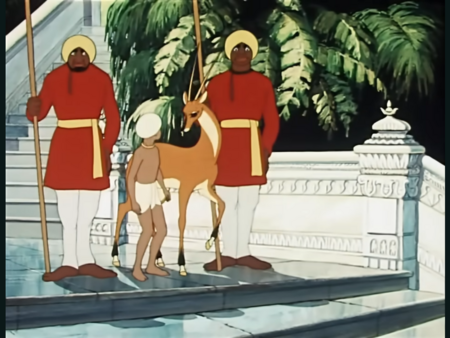
«Golden Antelope» (1954)
«Golden Antelope» (1954)
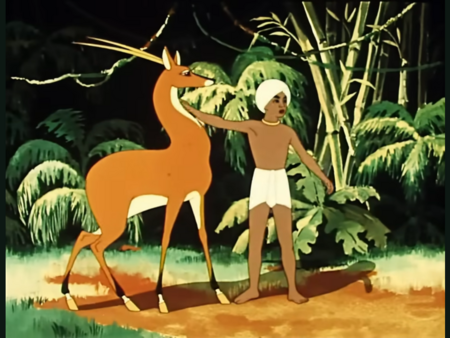
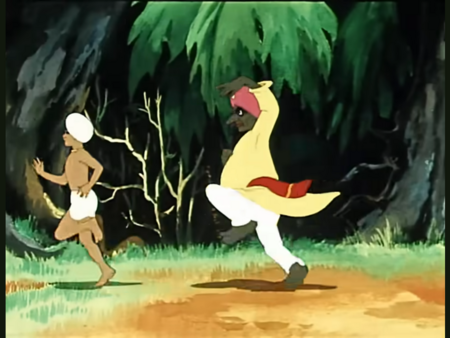
«Golden Antelope» (1954)