Explainer on the nature of visual errors in artificial intelligence. This project explains why neural networks distort anatomy, text, geometry, and object construction, how these errors arise, and why we don’t always notice them at first glance. Through illustrative examples and diagrams, the unique characteristics of image generation and the limitations of neural networks are revealed.
Introduction to the Topic
Today, neural networks can generate images that appear convincing—and even impressive—at first glance. However, upon closer inspection, they often contain errors: extra fingers, bizarre objects, illogical spaces, or distorted text. This raises a question: if an image looks realistic, why are there so many visual glitches in it?
What does a neural network actually do?
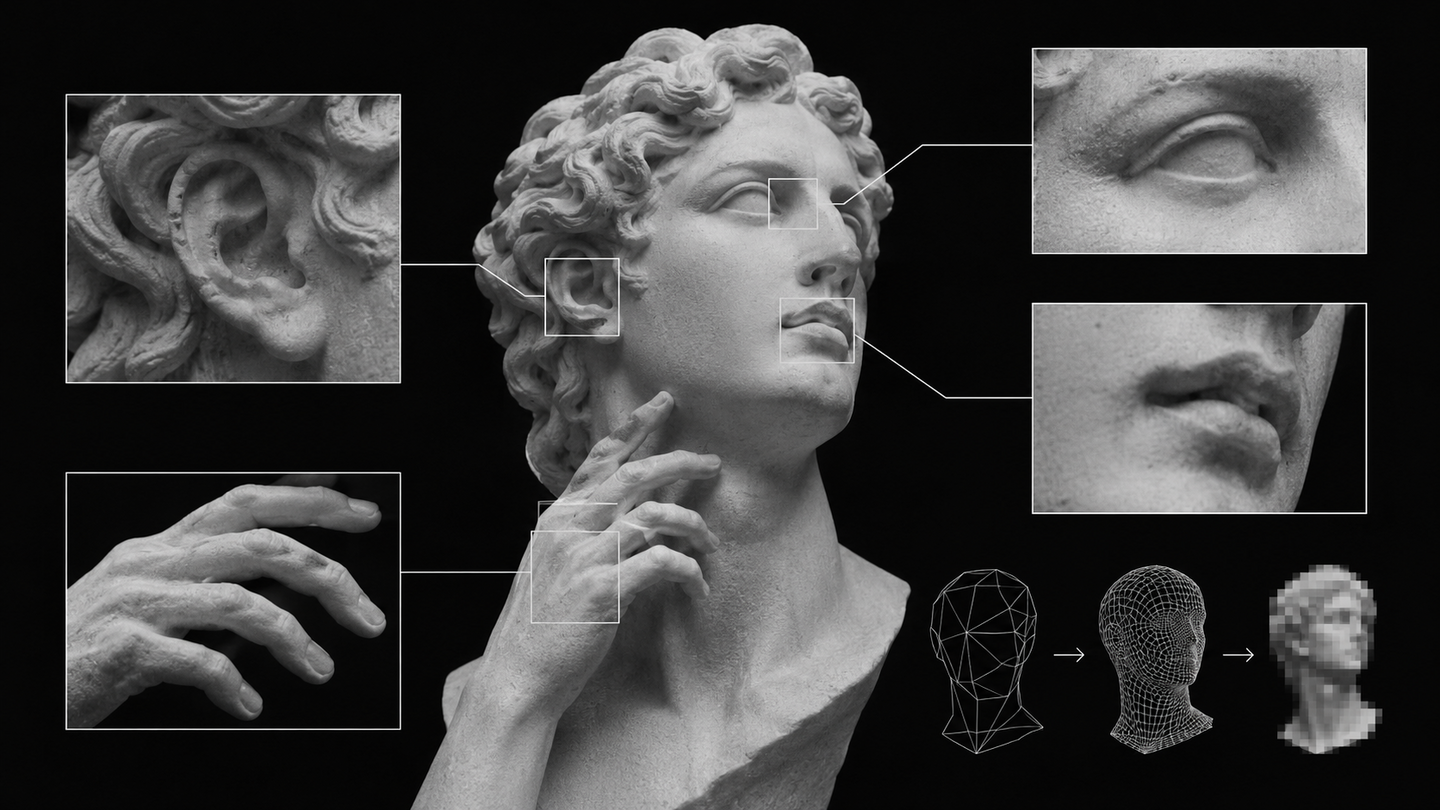
A generative neural network does not create an image the way an artist or designer does. It does not observe the world directly or interpret it like a human. Its task is to predict, based on a massive amount of data, which visual elements should appear next to each other to form a plausible image.
Why does the image look right?
Neural networks excel particularly at the external persuasiveness of an image. They can imitate lighting, textures, depth, focus, materials, and even the mood of a scene. Consequently, a picture can look extremely realistic. However, a realistic surface does not yet mean that the neural network genuinely understands the form, function, and internal logic of the depicted objects.
Where do errors come from
Errors occur because the neural network operates on probabilities, not on world knowledge. It matches words, forms, and visual patterns, but it does not verify the result the way a human would. For it, what matters is that the image resembles many images it has already seen, rather than that it is logically flawless.
Error #1: Anatomy
One of the most well-known issues with neural networks is anatomical errors. This is particularly noticeable in hands: they might have too many or too few fingers, fingers might merge, bend unnaturally, or lose logical connection. This occurs because the human body is an extremely complex system, and the hands are especially variable in terms of pose, angles, and positioning within the frame.
Why Hands?
The hand has almost become a symbol of neural network errors for a reason. It has a complex structure, numerous joints, and a vast number of possible poses. Furthermore, the fingers frequently overlap, making the structure less apparent in the image. While a neural network can grasp the general form of a hand, it often falters in the intricate details of its construction.
Error #2: Text and Letters
Another common mistake involves text issues. An AI model can design a sign, poster, or packaging, but instead of words, strange sequences of characters often appear—they resemble a language but are not one. This happens because the model often perceives text within an image as a visual form rather than a strict symbolic system with its own structure.
Why Neural Networks Struggle with Letters
To render the text correctly, it is not enough to make it «look like text.» You must preserve the sequence of letters, the form of the characters, the spacing, and the readability. This is particularly difficult for a neural network because, when generating images, it prioritizes visual plausibility over linguistic accuracy.
Error #3: Space and Perspective
Neural networks also make errors in spatial construction. The image may feature impossible staircases, illogical interiors, strange object intersections, or a violation of perspective. While such a scene may look convincing in a general overview, upon closer examination, it becomes clear that parts of the image do not cohere into a unified spatial system.
Error #4: Object Logic