Media Concept
PO.SCRIPTU examines the habits we acquired online.
The focus areas include internet language, messaging app communication, visual aesthetics, personal boundaries, and ways of self-representation online. Instagram is the primary platform for publications. We plan to release one detailed carousel per week, supplementing these with short observations and reader questions in between.
Data Sources
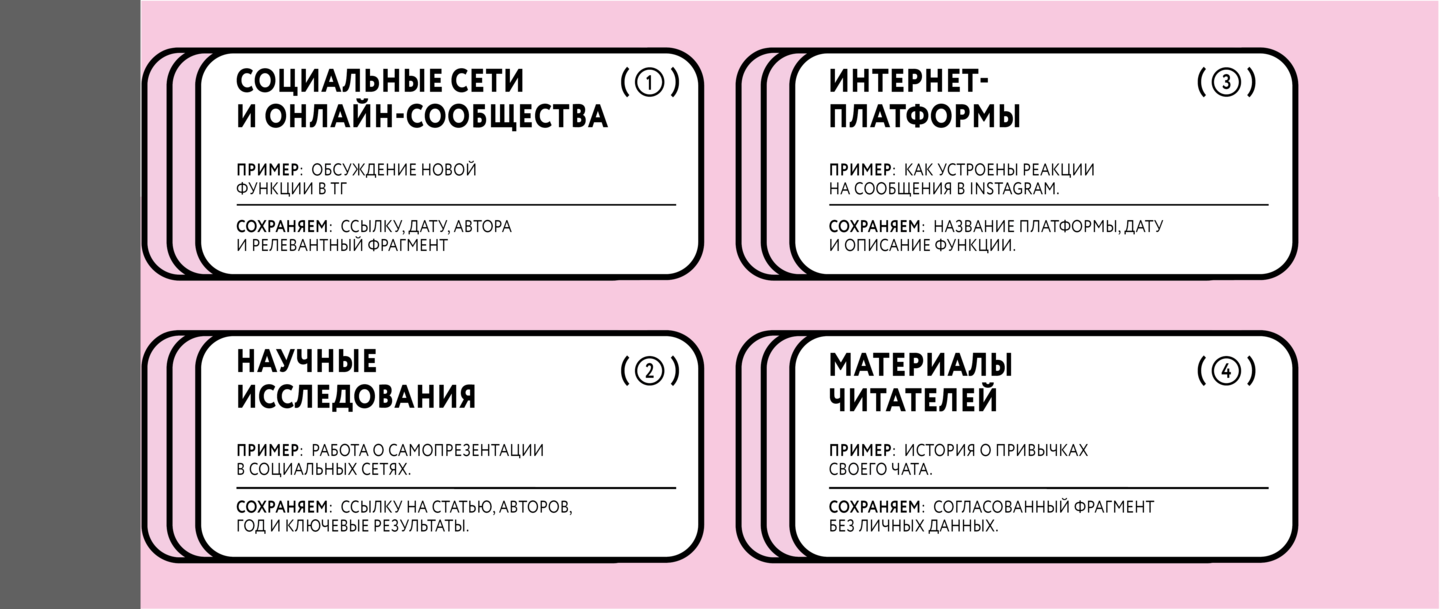
(1) We search open social media platforms and channels, taking screenshots. We save the platform, the date, the link, and the relevant snippet.
(2) We search for academic articles on digital communication and online behavior using Google Scholar and university websites. We save the authors, the link, and the main findings.
(3) We interview authors who publish media content types relevant to us. We save the exact quote and the publication it belongs to.
(4) We select cases from comments under our posts that either supplement the analysis or require us to refine a conclusion. We save the question, the answer, and the agreed-upon method of its use.
Source Card
We create a record for every material in the master table.
For every material, we create an entry in a master table. From this table, you can return to the original, locate the necessary excerpt, and determine which issue it will be used in. Here, we also mark any questions that need to be addressed before publication.
Data Processing Schema
Missing confirmation? Let’s go back to the source.
First, we gather and verify the materials. Then, we formulate the conclusion, prepare the text, and select visuals. The finished layout undergoes editorial review. After publication, we analyze the feedback and incorporate new questions into the plan.
Guidelines for Automated Services
For the initial releases, we suggest maintaining the database in Google Sheets, and using an AI assistant to analyze the selected materials and prepare the draft. The editor will be able to see which record in the spreadsheet each quote originated from.
Each service receives a specific task and the necessary materials to work with. The resulting output must allow the editor to revert to the source material to verify the text. If information is missing, the service flags the gap and passes the question on to a human.
For the draft, we utilize already-verified records. This helps maintain a connection between the discovered information and the final publication.
Editorial Guidelines
(1) Fact-check sources. We clarify contradictions and gaps before publishing. (2) We consider the platform, community, and context in which the habit emerged. (3) We separate observations from assumptions. Conclusions are supported by research and participant quotes. (4) We write clearly, explain terminology, and select visual examples that help clarify the topic. (5) We approve the use of personal stories and correspondence. Participant data is anonymized, and image sources are cited. (6) The editor reviews the text, images, and links, approves the publication, and corrects any errors found.
How will we know the format is working?
After launch, we will monitor which publications are most frequently saved and shared, taking into account reach and comments. This will help us select future topics and understand what readers want to discuss in more detail.
Separately, we will assess the time spent on researching, vetting, and preparing materials. This will clarify where automation helps maintain the weekly release and which stages require refinement. Once we build a consistent audience, we can propose joint media-themed publications to partners.
We will evaluate reader interest based on saves, shares, and comments. We will calculate the preparation time for each issue. Based on this data, we will adjust topics, content volume, and service objectives.