Concept
I first saw a reproduction of the painting «What a Space!» when I was fourteen, and I still remember the feeling of stubborn, almost unwavering disbelief when I learned who painted it. I passed the art history course at the art school with honors, and the idea that it belonged to Ilya Efimovich Repin—a realist artist I was well acquainted with, author of «Barge Haulers on the Volga» and «They Didn’t Expect It"—initially seemed impossible.
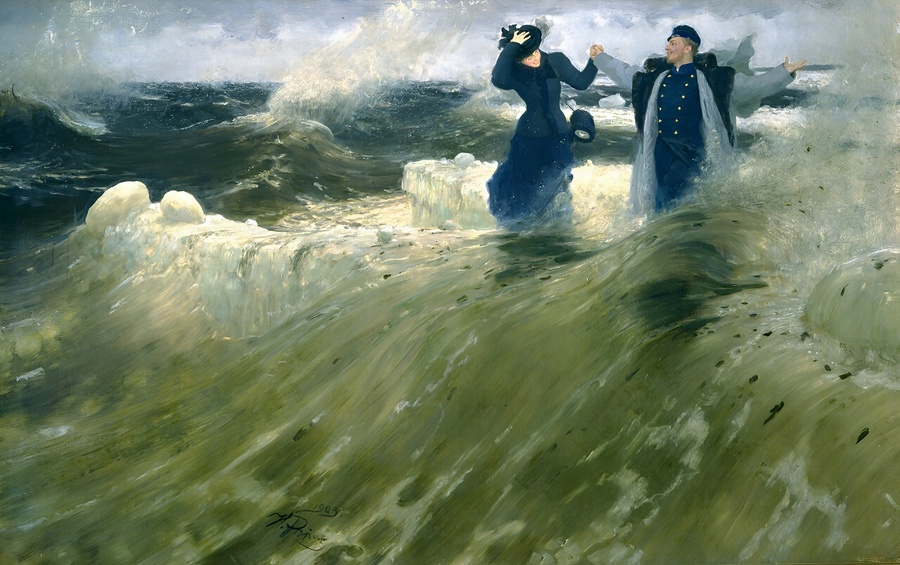
I. Repin, «What a Space!», 1903
This painting continues to draw me in with its mystery. Painted in 1903, it depicts a small scene from the lives of two young people caught unaware by a wave. It does not convey any historical event; there is no obvious dramatic or social conflict, nor the typical psychological tension found in Repin’s work. Instead, there is movement, open space, the play of waves, and the sensation of a moment about to vanish. Even the title, «What a Space!», seems more like an immediate emotional exclamation than an attempt to articulate any grand idea.Yet, the artist’s contemporaries were not quick to settle for such a simple reading. The canvas sparked debate—viewers attempted to imbue it with symbolic and even political meanings; the public perceived in it a premonition of the coming revolutionary turmoil [1].
Here, he momentarily stepped away from his innate realism and truth, moving into the realm of «allegories, ” metaphors, and mysterious shells—and was absorbed by a current alien to him.
The artist himself gave unambiguous comments regarding the painting’s meaning. The St. Petersburg newspaper «News of the Day, ” which covered the excitement surrounding the painting during the exhibition, reported that „Repin himself… energetically defends himself against this and similar slander. ‘What symbol! Sir, for symbols and fops, just a student with a young woman from the sea dances the mazurka; that’s all! ’“ [3]. Later, he repeated this sentiment in a private letter to M. Verevkina, complaining that „our public… sees that this is not for nothing, that a deep allegory is hidden here. And for this allegory, they either scold me, reproach me, or despise me“ [4].
But why did contemporaries seek hidden meaning in this painting, despite the artist’s steadfast resistance? And why did a work that could today be accepted as a perfectly logical example of the early 20th-century pictorial search elicit so many questions precisely because it belonged to Repin’s brush?
The aim of this study is to examine «What Space!» both within the context of Ilya Repin’s creative work and the artistic culture of the turn of the 19th and 20th centuries, in order to define the nature of its stylistic distinctiveness and to understand how the authorship influenced contemporary perception of the work. I hypothesize that the ambiguous reception of the painting may be largely determined not only by its visual characteristics but also by the context of its creation. Repin’s established reputation as a realist artist, along with the expectations associated with his work, compelled his contemporaries to seek additional meanings in this unusually conceived piece. Thus, the painting became a unique screen onto which perceptions of the artist’s persona and the anxieties of the era were projected.
Let’s examine what makes this painting so unlike the Repin we are accustomed to, and what it reveals about the artist’s standing on the art scene at the turn of the century.
Step 1. What are we actually seeing?
I. E. Repin, «What vast space!», 1903 (excerpt)
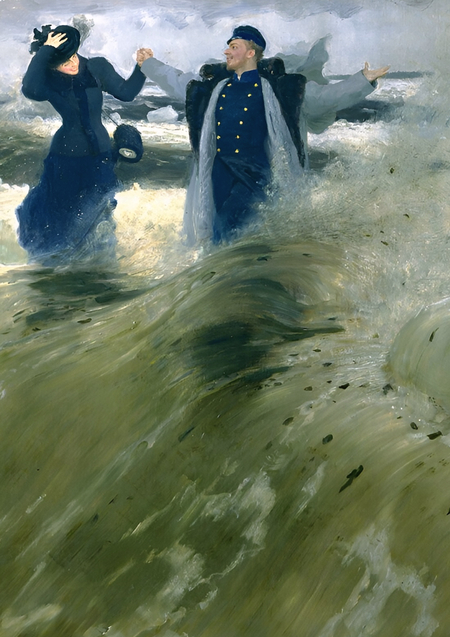
In the painting «What Vastness!» (1903), two young people are depicted amidst the stormy waves of the Gulf of Finland. The sea foams and crashes against the shore, and the first ice floes are visible among the waves. Against the backdrop of this primal force, the human figures appear small and vulnerable.
However, the characters’ behavior does not align with the impression of danger. The young man throws his arms wide toward the waves, and his companion stands beside him. Their poses convey excitement more than fear. They do not try to shelter from the bad weather; rather, they seem to be relishing the spectacle.
The gust of wind stirs the water and plays, breaking the ice floes. This amuses the young, while the audacity surprises the elderly artists so much that they paint a picture on this subject.
The artist recounted seeing this scene in Kuokkala, near his estate «Penati,» and was inspired by it when creating the work. Thus, at a primary, immediate level of perception, we have a simple scene from the lives of two young people. There is no obvious historical or social subtext—only the characters, the sea, and a moment of meeting with nature.
Step 2. What can be learned from pictorial techniques?
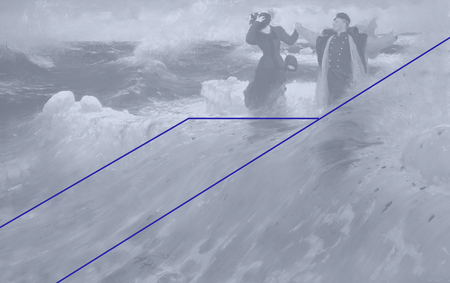
The most striking compositional feature of the work is the unusual relationship between the human figures and the surrounding space. The seascape dominates nearly the entire canvas, making the figures appear small against its scale. The diagonal of the oncoming wave creates dynamism and directs the viewer’s gaze toward the characters; however, this onslaught does not appear overly menacing—at the girl’s feet, the water’s movement calms down, smoothly transitioning into a horizontal line.
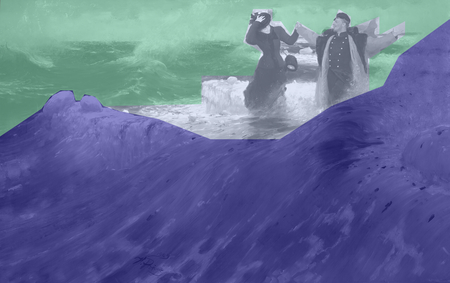
The compositional plans are almost divided according to theatrical staging. In the foreground, the high crest of a sea wave is clearly visible—intentionally shifted slightly to the right of the main characters—as if representing a looming threat in close proximity that is unable to overpower them. The middle ground features the characters themselves and a small parapet, which establishes a more stable horizontal line. The background is again composed of powerful and dangerous waves, framing the small, safe space occupied by the characters.Thanks to this compositional structure, the element of nature simultaneously appears immense yet relatively manageable for a human. It is noteworthy that in the sketch for the canvas, the scale of the waves is not emphasized as strongly, but it is precisely in the original that this scale reveals the work’s inner dramatic tension.
I. E. Repin, Study for the canvas «What Space!», 1903.
I. E. Repin, Study after the painting «What a Vast Space!», 1903, and its original, 1903.
The image of the sea itself has long been rooted in visual art and is connected to numerous artistic traditions. For example, in his work, Repin inherits the depiction of the sea element from the Romantic painters of the early 19th century, who were interested in the psychological connection between humanity and nature. For them, the image of water became a way to convey the inner world of a person during their confrontation with something vast and uncontrollable.
Caspar David Friedrich, «The Arctic Ocean» («Shipwreck of Hope»), 1923–1924; «Wanderer Above the Sea of Fog, ” 1818.
This theme is particularly vividly explored in the works of the German artist Caspar David Friedrich. In the painting «Wanderer Above the Sea of Fog,» a solitary human figure stands before the boundless expanse of water and sky. The scale of nature emphasizes human fragility, and the contemplation of the elements takes on an almost philosophical quality. For I. Aivazovsky, also closely tied to the Romantic tradition, the sea more often becomes a space of dramatic struggle between humanity and nature. In his works, the elements appear simultaneously destructive and majestic, and man finds himself facing mortal danger.
I. K. Aivazovsky, «Ship in Distress,» 1865.
Repin approaches the same theme but radically shifts its emotional tone. His characters are not isolated against nature nor do they feel helpless—quite the opposite; they are open to the elements and seem to embrace the challenge. The young man spreads his arms out toward the wave, demonstrating not fear, but exhilaration and freedom. In this, one can see the image of the new person—active, inspired, and ready to confront the unknown head-on. Thus, the romantic motif of the human versus nature transforms into the image of courageous acceptance of the elements.
The manner of writing is equally important. Repin uses broad, loose brushstrokes, which are especially noticeable in the depiction of water: the sea surface is composed of quick patches of color; some areas are rendered in detail, while others are left almost sketchy. Instead of sequentially depicting each wave, the artist conveys the overall impression of the movement of water, light, and air.
I. Repin, «What a Vast Expanse!», 1903 (excerpt); Claude Monet, «Étretat. Stormy Sea», 1883 (excerpt)
This picturesque style connects the painting to the creative explorations of Impressionist artists from the latter half of the 19th century to the early 20th century. They sought to capture fleeting moments—the momentary effects of light, the state of the atmosphere, movement, and everyday life. Instead of a smooth, academic technique, they employed quick and precise brushstrokes, allowing color and texture to participate autonomously in the creation of the image.
Claude Monet, «Impression. Sunrise, ” 1872
Claude Monet, «Haystacks at Giverny,» 1886 (excerpt); Ilya Repin, «How Wide the Space Is! ,» 1903 (excerpt)