from Greek κινητικός (kinētikos) — moving / capable to move
Kinetic Art a 20th-century movement where movement is not just a feature but the main means of expression. The artwork literally cannot exist without it.
The idea of movement in art is ancient. It first appeared in cave paintings, where early humans tried to capture basic motion — from an instinctive step to the majestic stride of a pharaoh. Later, movement developed in sculptures influenced by the environment, such as the Winged Victory of Samothrace, whose clothes seem to blow in the wind. Impressionist painters explored the subtle vibration of light and nature. Then, the Futurists, Dadaists, and Constructivists openly celebrated motion. However, the term "kinetic" was first applied to visual arts by Naum Gabo and Anton Pevsner in their Realistic Manifesto (1920).
Movement in kinetic art can achieved in several ways: through natural forces (wind, water etc.), mechanical motors, technological sources (electricity), or by the viewer’s direct interaction (interactivity).
examples of art works
Light-Space Modulator — László Moholy-Nagy, 1921-30
This unnamed kinetic machine combines light, shadow, and mechanical principles. It has three sections, each producing a different type of motion: jerky pushes (for rods), circular rotation (for discs), and spiral movement (for glass blocks). Coloured lamps turn on in a set sequence, creating a landscape of light and a composition of light and shadow.
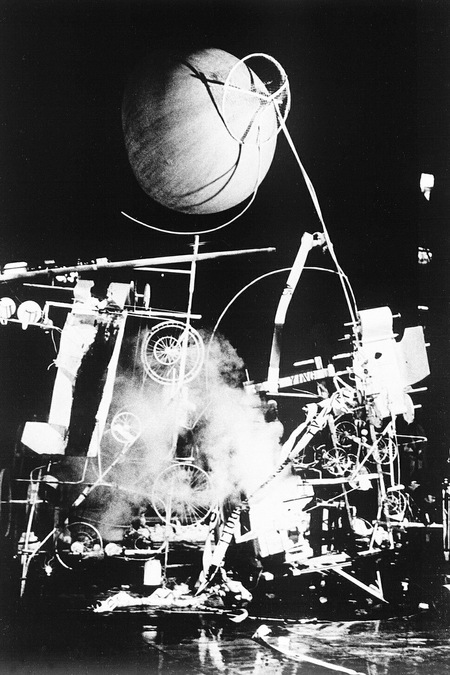
Homage to New York — Jean Tinguely, 1960
A self-destroying, self-decomposing artwork. It was created for a performance in the Sculpture Garden of the Museum of Modern Art (MoMA) in New York, made in collaboration with engineer Billy Klüver and artist Robert Rauschenberg. The machine’s program ran for 27 minutes, after which it exhausted and destroyed itself — it was a performance.
Concert for Anarchy — Rebecca Horn, 1990
This upside-down piano was a prop for Horn’s film Buster's Bedroom (1990). Set in a psychiatric hospital, the piano behaves like a living creature — sometimes getting upset, sometimes calming down, producing strange sounds and noises. Horn described it as: "Having freed itself from the psychiatric clinic, it now hangs upside down from the ceiling, composing its own music, developing a new tonality." [1]
key practitioners / artists
1. Naum Gabo (1890–1977)
on the left portrait of Naum Gabo and his work Kinetic Construction (Standing Wave) 1919–20; on the right — Linear Construction No. 2, 1970–1
Naum Gabo – His Kinetic Construction (Standing Wave) (1919–20) is often seen as one of the earliest examples of kinetic art. His innovation was the "stereometric method": form is created through intersecting planes, empty spaces, and edges, not by shaping solid mass. He was also among the first to use modern industrial materials (Plexiglas, nylon thread) to achieve a "dematerialization" of volume.
2. László Moholy-Nagy (1895–1946)
on the left portrait of László Moholy-Nagy and his work B-10 Space Modulator, 1942; on the right — Mobile Sculpture (Space Modulator), 1943
László Moholy-Nagy – A Hungarian artist and Bauhaus teacher, he was a pioneer in using light as an artistic material. He insisted that movement should be an essential part of sculpture and that the viewer should activate the work through their participation. He also attempted to create kinetic painting, as shown through his experiments with transparent Plexiglas on a flat surface.
3. Alexander Calder (1898–1976)
portrait of Alexander Calder and his work Croisière, 1931; on the right — Spirale, 1958 and Red Lily Pads, 1956
Alexander Calder – An American sculptor who invented abstract kinetic sculptures called "mobiles," moved by natural forces (air currents). His works play with balance, weight, and weightlessness, where each element can shift position at any moment.
4. Jean Tinguely (1925–1991)
firstly his portraits, then his works: Ballet des pauvres, 1961; Rotozaza No. 2, 1967
Jean Tinguely – A Swiss kinetic artist who created "meta-machines" from found objects, trash, and industrial parts. His mechanisms are chaotic, absurd, and often self-destructive. For Tinguely, movement is not about harmony but a critique of industrial society and technological optimism.
5. Rebecca Horn (р. 1944)
on the left — portrait of Rebecca Horn; on the right — Memorial Promenade, 1990
Rebecca's kinetic art works through themes of trauma, fragility, and bodily experiments. She blurs the line between human limbs and technical devices that "extend" them into space.
In Buster’s Bedroom, the central element is a wheelchair called Memorial Promenade. It exists on its own, without a person, almost replacing them.
My machines are not washing machines or cars. They have a human quality and they must change. They get nervous and must stop sometimes. If a machine stops, it doesn’t mean it’s broken. It’s just tired. The tragic or melancholic aspect of machines is very important to me. I don’t want them to run forever.
Horn creates imperfect and vulnerable machines — this is a unique branch of kinetic art. Unlike the ideal machines of the Constructivists, Horn’s mechanisms can stop or break down. This is not a failure; it is part of their life. She builds imperfect devices that spray paint on their own, making an artistic statement.
on the left — High moon, 1991; in the middle — The Little Painting School Performs a Waterfall, 1988; on the right — The lovers, 1991