Research Concept
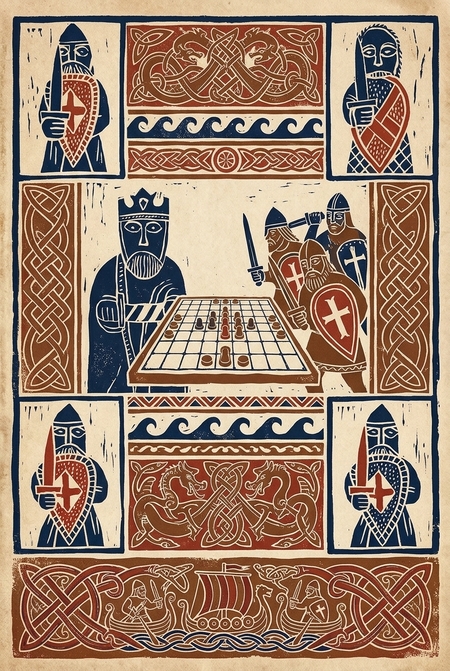
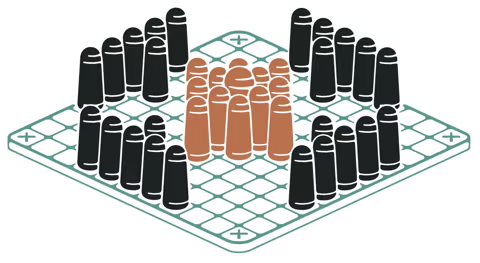
There is a game where the sides are inherently unequal, and no one considers this a mistake. In Khnefatafl, the king and twelve defenders are confronted by twenty-four attackers. This ratio of forces forms the foundation of the game, transforming inequality from a supposed flaw into the main principle of competition.
The study focuses on xnefataflu as a world model where participants occupy unequal positions and possess varying capabilities. The central focus is the relationship between the structure of the play space, the distribution of power, and player decisions. This interest in such an interpretation stems from the possibility of examining inequality not as a disruption of order, but as a foundational condition within which relationships among participants are formed.
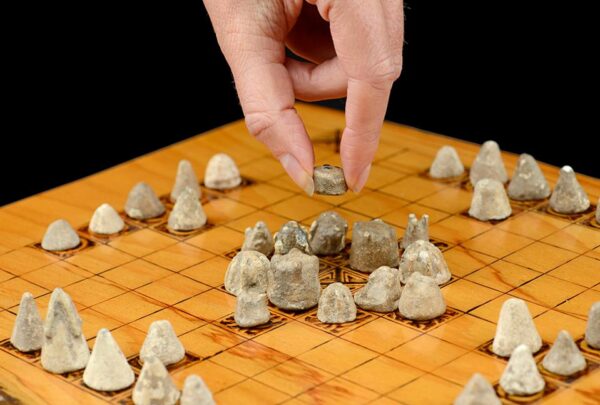
Lead gaming elements of the Viking age
Research Question
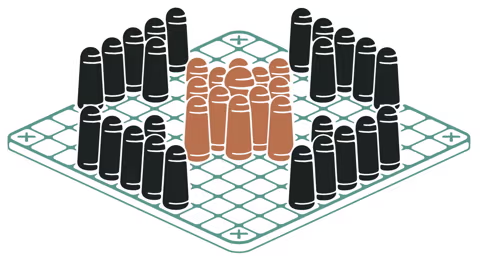
The main research question is: how is the inequality between parties expressed in the structure of the field, the placement of figures, and the available strategies? The hypothesis is that these elements form a cohesive model of opposition. In this context, a player’s autonomy is measured not by the absence of limitations, but by their ability to act within the given constraints.
Fragment of a game board from Trondheim, 11th–12th centuries
Relevance
Asymmetry has become a major focus in modern game design: games featuring factions governed by different rules have developed their own school and player community, and large communities have grown around these specific titles [22]. The reason goes beyond novel sensations. Once sides receive disparate capabilities, the very concept of fairness changes: starting parity gives way to parity of objectives, forcing the designer to calculate the value of a power advantage and determine how to balance it. This debate is not new—Hnefatafl tackled this very problem centuries ago, solving it on a bare board, without written rules or balance sheets. Therefore, an analysis of this ancient Northern game is relevant not only to historians; it reveals the origin of the question that game design addresses today.Simultaneously, Hnefatafl itself is experiencing a resurgence: championships have been held since 2008, an international federation exists, and a codified set of tournament rules has been established [19]. This old Northern game is proving to be more than a museum curiosity—it is an early prototype of what is now called asymmetric design.
Much has been written about the Khnefataphle, but nearly all of it comes from the work of chess archaeologists and historians: finds, dating, and the place of the game in the general lineage [6]. Less is written about how the game itself is structured. This work focuses precisely on the structure, demonstrating that the inequality between the sides was not an accident, but rather the core principle upon which the entire game rests.
The goal of this work is to demonstrate how the imbalance between the sides is defined within the game of Hnefatafl: in the board layout, the placement of pieces, and the differences in objectives. Related to this is the second task—to analyze what role this structure assigns to the player and why a game with predictably unequal forces was considered fair.
First, one must understand what kind of game this is and where we know about it; next, how it is constructed and what its structure signifies for game theory and our conception of the world. Only then can we address its subsequent fate. This logic determined the structure of the paper:
- Research Concept
- A Thousand Years of One Game
- Rules for Two Unequal Parties
- Agon, Alea, and the Boundaries of Game Theory
- The Model of an Unequal World
- Loss and Return of the Game
- Conclusion
- Bibliography
- Image Sources
A Thousand Years of One Game
In Russian monuments, the same game is known as tavlia: Dal defines it as a checkers or chess board with pieces, and the word itself comes from Greek [21]. The word tafl in Old Norse meant a board and a board game and encompassed an entire family [6]. The name khnefatafl is composed of two parts: hnefi — fist, which was the name for the king piece, and tafl—the board.
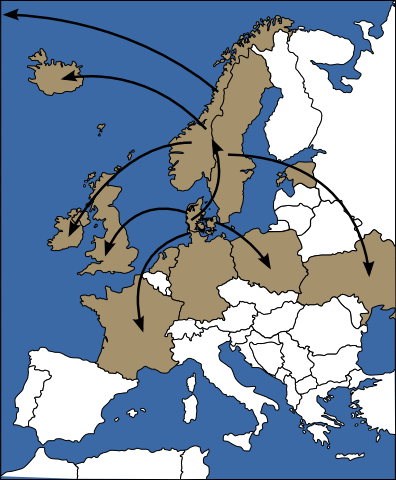
Board games are known across the North: Brandubh in Ireland, Taulbord in Wales, Tablut among the Sami, and Alea Evangelii in England. They share a common principle: pieces move in straight lines, capture surrounding pieces, and the king must either be lured away or captured. The size of the board and the number of pieces differ.
Contemporary sets of historical games: Hnefatafl, Tablut, Fidchell, and others. La Plazoleta Artesanos Workshop
Khnefataphl is known not only for its components but also for its texts, which is rare for a board game.
In «Voritsanie Velyvy,» the gods play at tables on the Idavoll meadow and lack no gold while the world endures; after the world perishes, the survivors return to the same meadow and find the former golden figures in the grass [3]. The game here serves as a symbol of the golden age and a sign of its restoration: the cosmos is depicted as a game that can be lost and restarted.
«The Saga of the Orkneyinga» shows the respect given to the skill of playing: Earl Rognvald Kali Kolsson, who ruled the islands in the 12th century, lists nine of his arts, starting with tafl [4].
In «The Saga of Hervor and Heidrek,» Odin, disguised as a traveler, competes with the king in riddles, one of which describes a board with figures as a battlefield [5]. This is relevant to our topic: the game here is no longer just entertainment, but a subject of general education, capable of being turned into a riddle.
Rules for Two Unequals
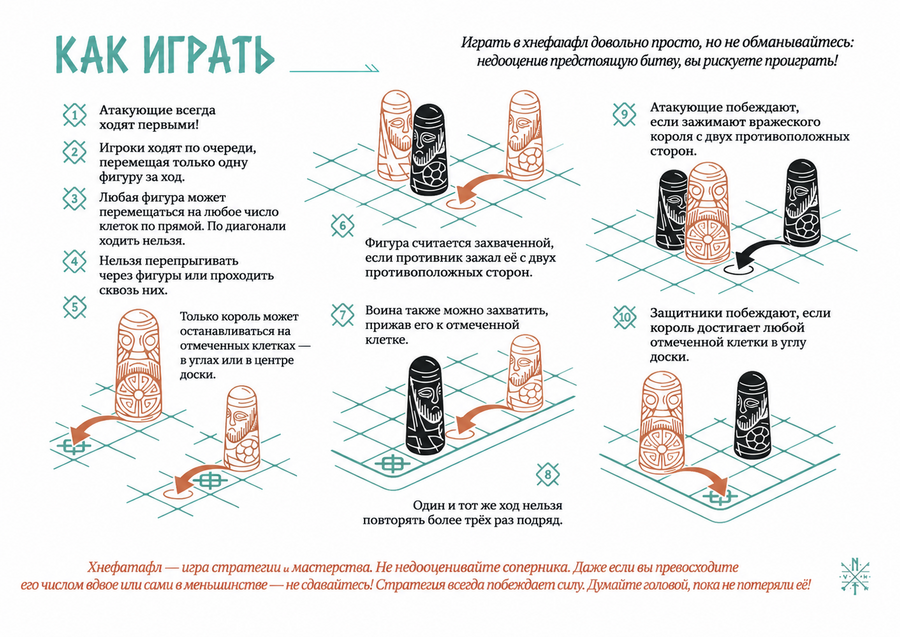
The game variations differ in the board size and number of pieces, but the ratio remains consistent.
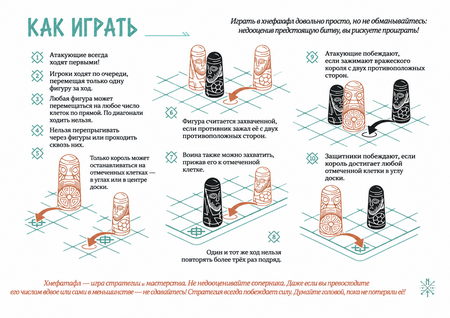
The asymmetry here is twofold. The forces are uneven—there are twice as many attackers. The goals are also uneven: defenders only need to push the king to the edge or corner, while attackers must capture it. The strong side is obligated to attack because inaction is tantamount to defeat for them; the weak side can afford to be patient.
The numbers are compensated by position: the center and the first move versus the periphery and the advantage. This leads to a conclusion that is rarely articulated: the two sides play differently. The attacker needs traps and pressure, while the defender needs risk calculation and a willingness to sacrifice pieces for a breakthrough. These are two different games in the same box, and a player’s strength is measured separately for each role.
Tournament practice has reinforced this: games are played in pairs with alternating sides so that every player experiences both being the besieger and the besieged [19].
Agon, Alea, and the Boundaries of Game Theory
Kayuah demands equal conditions from agon: competition assumes that players start equally and victory belongs to skill [2, p. 49]. Hnefatafl violates this condition directly.
However, the competition does not disappear—it shifts from power to conception. Players compete not with equal means, but with ways of equal difficulty to achieve asymmetrical goals. The stronger side must earn victory through the art of siege, while the weaker side must achieve it through the art of breakthrough.
Within the game, alea also lives, but not as a dice roll, but as a lottery in the old sense of the word: the side is not chosen; it is received. Vygotsky described how a child voluntarily renounces immediate desire for the sake of a pretend situation [12, p. 66]; the adult player does the same, agreeing to be strong or weak not by choice, but by the design of the game.
The case in the hennafatafl is unusual: it is not inside the set.
No bones, no cards are discarded here; all moves are open, and the opponent sees exactly what you see. But chance is still a factor—it is drawn outside the board. Fate determines the side, not choice: the player is assigned a role, they do not select it.
Kaioua related alea to games where destiny decides the outcome [2, p. 49]. Here, destiny does not decide the outcome, but the starting position—and this is enough for the game to cease being a pure contest of skills. This is why tournament practice involves paired matches: if roles are distributed randomly, the only way to equalize the players is to let each one experience both roles.
There is also a theatrical dimension. The board is not an arena of equals, but a small drama with distributed roles: a besieged king, a loyal retinue, an advancing horde. The game communicates to the player not only a task but also a role complete with character.