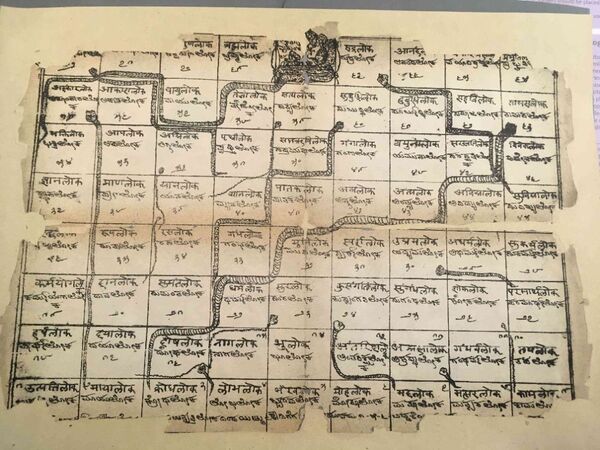
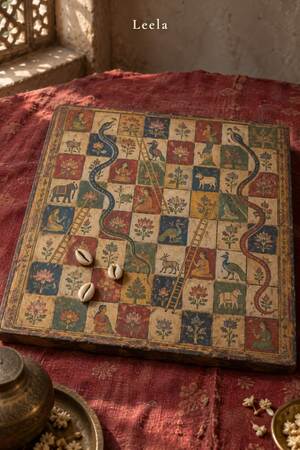
Gyan Chaupar / Leela Game Boards
Concept
A board game can represent the world in a miniature form. The game board establishes the space, the rules define causality, the piece is given permissible directions of movement, and a random roll alters its position. In most familiar modern games, this system describes competition, economics, warfare, journeying, or achieving a specific goal. However, there exists a distinct historical group of games where movement across the board relates to the structure of human life—karma, reincarnation, moral actions, the afterlife, or achieving spiritual liberation. The player finds themselves within a model of the world where abstract categories take the form of cells, routes, obstacles, and transitions.
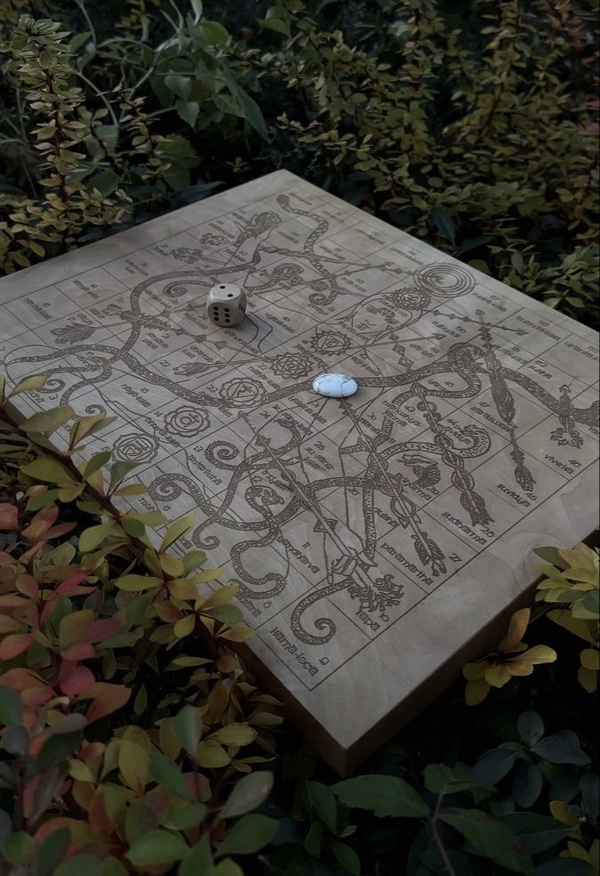
This research is dedicated to six such traditions. The Indian Gyan Chaupar transforms religious and ethical states into a vertically organized field featuring rapid ascensions and descents. Contemporary Leela Harish Johari preserves this playful grammar, transplanting it into the context of later self-knowledge practices. The Tibetan game sa gnon rnam bzhags, known in English-language literature as The Game of Rebirth or The Game of Liberation, organizes Buddhist cosmology as a system of potential transitions between worlds, states, and paths of practice. The Chinese Xuanfo Tu translates the model of administrative promotion into a Buddhist system for achieving Buddhahood. The Egyptian Senet represents an earlier and independent tradition: in the New Kingdom, its thirty-square-cell field was linked to traversing the afterlife. The Sufi Gyan Chaupar shows how the same mechanical structure of snakes and ladders could be integrated into the Islamic mystical depiction of the spiritual journey. The Korean Seongbuldo transforms the path to enlightenment into a social game, where the religious formula is embedded directly into the mechanics of the throw.
These games cannot be unified under the claim of a single ancient ancestor. The historical connections between individual traditions vary in terms of evidentiary support. Gyan Chaupar and its Sufi variations belong to a single family of Indian board games. Leela Johari is a contemporary, original interpretation of that same broad tradition. The Chinese, Tibetan, and Korean Buddhist games reveal similar methods for transforming soteriology into a game system; however, specific historical evidence is required for each particular tradition. Senet originated thousands of years before the other games under consideration and is included in this study as an independent example of the religious reinterpretation of a board game. This distinction is fundamental: visual similarity in the board or a shared theme of spiritual ascent does not, in itself, prove genealogical kinship.
The relevance of this topic stems from the development of research into material religion and the history of games. In works from the last few decades, religious playfields have been viewed as systems where doctrine exists simultaneously in the imagery, text, rules, and player action. Jacob Schmidt-Madsen’s 2019 dissertation systematized nearly 150 Gyan Chaupar fields. Beverly Folks Maguire’s research demonstrated how Xuanfo Tu connected recreational play, learning, and religious practice. In 2026, Jin Seong and Hyungon Moon extensively studied Seongbuldo as a form of Buddhist education. These works allow the field to move beyond the question, «What is depicted on the field?» toward the more substantive query, «How does a worldview transform into gameplay?»
The novelty of the comparative approach lies in juxtaposing the mechanics of the spiritual journey itself. Key elements include the direction of movement, the structure of the space, the role of chance, the possibility of sudden ascent or descent, the method of concluding a round, and the relationship between the outcome of a roll and religious causality. This approach enables the analysis of the field as a functioning model of the world. The practical significance of this research also extends to contemporary game design. Historical spiritual games illustrate how an abstract idea can be distributed across space, rules, and actions. Meaning arises not just from the labels on the squares; it is formed by what the player is forced to do—awaiting a roll, accepting a fall, retracing a path, choosing a permissible transition, assisting another player, or exiting the game space upon completing the route. Historical examples allow us to view game mechanics as a tool for modeling worldviews.
Research Question: How do the game board, the randomness of the roll, and the movement rules transform a board game into a model of human fate, karma, and spiritual development? Hypothesis: The spiritual content of these games is created through the interaction of three levels. The board establishes the world’s structure, the rules establish causality, and the piece’s movement transforms this causality into an experienced sequence of events. Therefore, similar mechanics can carry different religious meanings, and similar religious goals can be expressed through different game systems.
The study utilizes the concept of alea from Roger Caillois. Caillois applies this term to games where a significant portion of the outcome is ceded to chance, and the player makes a decision outside of their control. For sacred games, this category is particularly useful because nearly all examined systems employ dice, sticks, or other random generators. However, alea describes a gameplay structure; the religious significance of the roll must be established separately for each tradition. Chance in a game can signify fate, karmic consequence, a ritually sanctioned choice, or simply a mechanism for distributing possible moves. Caillois is included in the course literature, so his concept provides the research with a common theoretical language without artificially reducing different religions to a single model. Johannes Huizinga viewed play as a distinct cultural form possessing its own rules, boundaries of space, and time. For the subjects under consideration, the connection between the conditionality of play and profound religious content is especially important. The playing field can remain a space of play while simultaneously fulfilling a pedagogical, ethical, or ritual function.
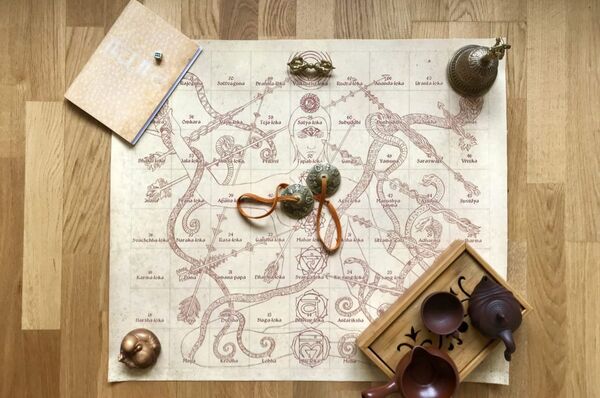
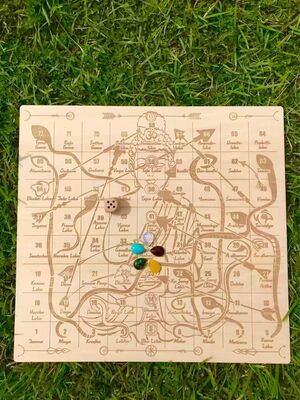
Game Fields Leela
Research Topic:
1. Gyan Chaupar and Modern Leela.
2. The Tibetan Game of Liberation.
3. Xuanfo Tu.
4. Senet.
5. Sufi Gyan Chaupar.
6. Seongbuldo.
7. Comparing Spiritual Path Mechanics and Hypothesis Testing.