Content
- Concept
- Section 1: Background; Introduction of Islamic art in Africa.
- Section 2: Islamic Teachings on Art and Aesthetics; reference from Prophet Muhammad’s (PBUH) Hadith.
- Section 3: African Artists influenced by Islamic art styles. (Case study: Ibrahim El-Salahi, Ahmed Mohammed Shibrain, Yelimane Fall, Rachid Koraïchi, Ali Omar Ermes, Amir I. M. Nour)
- Conclusion
- List of images and bibliography
Research Concept
This visual research aims to go beyond the simple idea that Islam bans certain types of images. Instead, it looks at how Islamic theology, philosophy, and visual culture have deeply influenced the style and ideas behind contemporary African art. The main idea is that Islam’s impact goes much further than decoration it forms a key aesthetic and intellectual framework for many African artists. The study outlines the religious rules about art in Islam. Unlike the common belief that Islam forbids all images, it explains the more detailed guidance based on tawhid (the oneness of God) and the resulting prohibition of shirk (idolatry). Historically, this has meant avoiding realistic images of prophets and divine figures in religious settings, but it has also put non-figurative art forms in the spotlight. Traditions like calligraphy, geometry, and arabesque (vegetal and floral patterns) are seen not just as decoration, but as complex visual methods to reflect on infinity, order in creation, and the divine word. In architecture, attention will be given to ideas about light, spatial order, and direction (qibla), which turn buildings into spaces for meditation.
The research tracks how these ideas spread into Africa, focusing on trade routes across the Sahara, networks along the Swahili coast, and Islamic learning centers like Timbuktu. This background helps explain the rise of a unique Afro-Islamic style, where Islamic design mixed with local African symbols, materials, and artistic goals. The core of the project explores contemporary African artists who engage with this heritage, showing that Islam’s influence is alive and evolving. In the end, the research argues that for these artists, Islamic aesthetics offer important tools to explore questions of postcolonial identity, globalization, and politics. Calligraphy serves to reclaim language and culture; geometry provides a universal way to talk about order and chaos; and the values behind Islamic art like humility before God and respect for craftsmanship challenge Western ideas of art as purely personal expression. By looking closely at material, technique, symbolism, and space, the study shows how contemporary African artists are not just keeping tradition alive, but actively reworking Islamic art principles to create a unique and globally meaningful contemporary art. The research finishes with a visual essay that puts historical Islamic art side by side with modern works, showing a continuous thread where faith shapes form and where spiritual meaning and artistic style are deeply connected.
The research started from noticing that many contemporary African artists often use calligraphy, geometric shapes, and architectural features linked to Islamic visual culture. However, curators and scholars usually treat these elements as just decoration or symbols of spirituality, without looking into the deeper theological and historical meanings behind them. This leads to the main question: how do these artists work with Islamic aesthetics like calligraphy, geometry, spatial layout, and ideas about materials to shape identities, express spiritual stories, and raise critical viewpoints in the setting of postcolonial and global contemporary art? The idea is that these artists aren’t simply repeating traditions. Instead, they rethink and use Islamic aesthetics as a flexible language to express Afro-Islamic identity, push back against Western-dominated art histories, and engage with current issues such as migration, political struggles, and environmental concerns. In doing so, they turn old Islamic principles into new ways of creative and intellectual resistance.
Section 1: Background: Introduction of Islamic art in Africa
«Great Mosque of Kairouan (also spelled Qayrawan) prayer hall façade», Anne Walker, CC BY-SA 2.0) 2026 Smarthistory.
The coming of Islamic art in Africa was not a single solid event, it spread gradually along with Islam starting in the 7th century CE. After the Hijra to Medina, Muslim armies and traders moved west from the Arabian Peninsula, first taking over Egypt, then spreading across North Africa. This early expansion introduced key features of Islamic art: avoiding figural images in religious settings, focusing on calligraphy to honor the divine word, and creating geometric and plant-based arabesque designs. The earliest forms of Islamic art in Africa appeared in architecture, like the great mosques of Kairouan in Tunisia (founded in 670 CE) and the Ibn Tulun Mosque in Cairo (9th century).
Rendering of the Great Mosque of Kairouan, Tunisia. From left to right: zoom on the south wall global view of the mosque, zoom on the minaret seen from the court, 2026 Smarthistory.
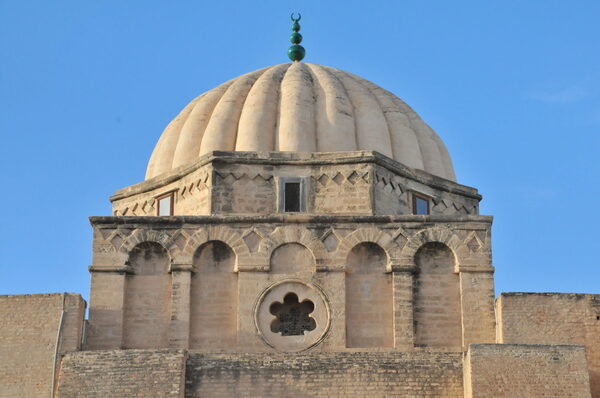
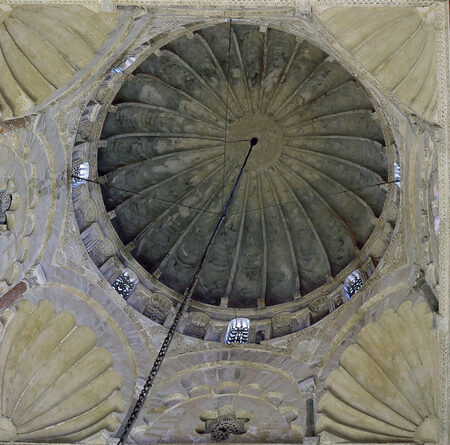
«Interior and exterior view of the dome above the mihrab, Great Mosque of Kairouan.» Issam Barhoumi, 2026.
The Aghlabid emperor erected a dome over the central arches and gateway and decorated the courtyard entry to the prayer area in the late ninth century. The location of the mihrab, or prayer niche, on the same central axis and beneath a cupola to denote its significance, is highlighted by the dome. It was clearly articulated that this dome is an architectural feature borrowed from Byzantine and Roman architecture. The otherwise dark interior was illuminated by the tiny windows in the dome’s drum above the mihrab area. The mihrab, the mosque’s most important feature, is surrounded by rays. The drum is supported by squinches, which are tiny arches with shell over rosette patterns resembling those found in Umayyad Islamic, Byzantine, and Roman art. According to architectural historian K. A. C. Creswell, the stone dome resembles a sliced cantaloupe because it is made up of twenty-four ribs, each of which has a little corbel at its base.
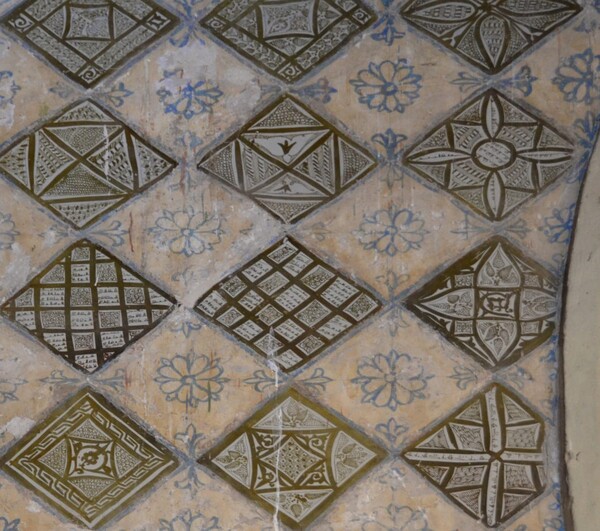
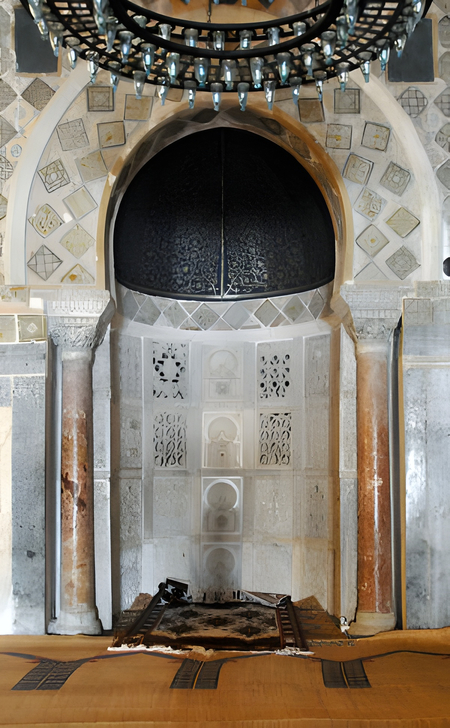
«lustre tiles that surround the mihrab», Richard Mortel .“Mihrab, interior view of the dome, Great Mosque of Kairouan Tunisia», Citizen59, 2026.
Openwork marble panels with geometric vine and floral patterns adorn the lower part of the mihrab. The panels are from the Syrian region, even though the too ornate mihrab is distinctive. Iraqi luster tiles surround the mihrab. They also have stylized flower designs similar to those found in eastern Islamic and Byzantine art.
«Minaret, Great Mosque of Kairouan», Ross Burns/Manar al-Athar, CC BY-NC-SA 2.0
The enormous square Kairouan minaret is one of the highest buildings in the area, rising to a height of around 32 meters, or more than 100 feet, and may have been inspired by Roman lighthouses. Thus, the minaret not only serves as a site to call for prayer but also serves to define the city’s religious identity by identifying the mosque’s presence and location. It also confirmed the significance of the mihrab because it was positioned slightly off the axis.
The ibn tulun mosque in Cairo (9th century). 2026, SeoEra.
These buildings (Ibn tulun mosque and Great Mosque of Kairouan) served as models for sacred spaces across Africa. They brought in features like the hypostyle prayer hall, the mihrab (prayer niche), and the minaret. Their decoration carved stucco, glazed tiles, and detailed wood panels set a new visual style that would blend with local customs over time.
Great Mosque of Djenné, Mali, 1907», Martha de Jong-Lantink, CC BY-NC-ND 2.0
From North Africa, Islamic art and culture spread deep into sub-Saharan Africa mainly through two routes: the trans-Saharan trade paths and the maritime networks along the Swahili coast. In West Africa, rulers in Ghana, Mali, and Songhai adopted Islam for trade and learning, and they had artisans build mosques from durable materials like stone and fired brick, but especially sun-dried mud. This led to the unique Sudano-Sahelian style, best seen in the Great Mosque of Djenné in Mali (first built in the 13th century). Its wooden beams sticking out (toron), thick buttressed walls, and many roof pinnacles weren’t just copied from places like Cairo or Córdoba. Instead, they reflected a local reinterpretation that met both spiritual and practical needs. Islamic art here went beyond buildings, influencing calligraphy (such as decorative Qur’ans in Maghrebi script), leatherwork, and brass-casting for royal items, where Arabic writing mixed with traditional figurative designs.
At the same time, a different blend happened along the Indian Ocean coast from Somalia to Mozambique, giving rise to Swahili art and culture. Islam came here mainly from the 10th century, brought by traders from Persia and the Arabian Gulf. This tradition is known for coral stone towns like Kilwa Kisiwani (Tanzania) and Gedi (Kenya), which had finely carved coral stone mihrabs and tombs, private courtyards, and sunken gardens. Swahili Islamic art showed a mix of influences: detailed plasterwork and carved wooden doors with lotus and floral patterns echoed styles from India and the Far East. Chinese porcelain was often embedded in walls and tombs as a sign of wealth and beauty. Although calligraphy remained important, figural images were accepted in secular art, with carved ivory, silks, and pottery showing human and animal forms a clear difference from the stricter aniconism in North Africa.
An 800-year-old pre-Mali Empire Qur’an from the year 1215, illuminated manuscripts were common among the Qu’ran found in Timbuktu.
The spread of Islamic art in Africa was a process of active adaptation, not just reception. While shared elements like geometry, calligraphy, and sacred spaces linked them, it was the unique social, economic, and artistic backgrounds of African societies that shaped Islamic art into something local. From inscribed pottery in the Sahel to the coral stone cities of the Swahili coast and the illuminated manuscripts from Timbuktu, Islamic art became truly African. Instead of wiping out native traditions, it engaged in a long, complex conversation with them, creating hybrid forms that were both Islamic and genuinely African. This early period laid the groundwork for later developments, including the arts of the Sokoto Caliphate and the court culture of Ethiopian Harar, making sure that Africa’s art history would always carry the mark of this important cultural encounter.
Section 2: Islamic Teachings on Art and Aesthetics
Islamic teachings about art and beauty really come from a deep love for beautiful things. But at the same time, there are clear rules about what’s okay to do and what’s not. The main idea comes from a famous Hadith where Prophet Muhammad (PBUH) said, «Allah is beautiful and loves beauty» (Sahih Muslim). This saying tells us that beauty is a part of God, and making or enjoying beautiful things is encouraged. The key is to do it in a way that doesn’t go against the main beliefs. So, in Islam, beauty isn’t just about looking nice; it’s connected to spiritual ideas like balance, order, and remembering God. However, this love for beauty is guided away from trying to copy God’s unique way of creating life. Instead, it’s directed towards art that shows God’s unity and greatness.
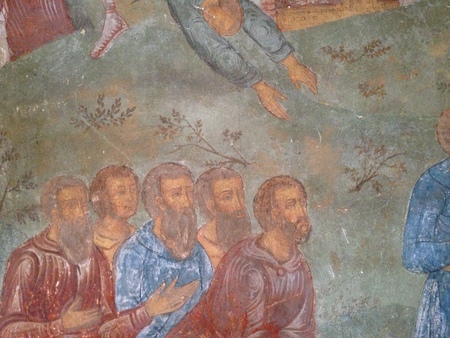
Note: This type of artwork is considered haram (NOT ACCEPTED) in Islam.
The clearest guidance from the Prophet is about visual arts like drawing, painting, and sculpting, especially when it comes to showing living things (people and animals). Prophet (PBUH) gave strong warnings against making such images, which is called taswir in Arabic. In a widely known Hadith found in Sahih al-Bukhari and Sahih Muslim, he said: «Anyone who makes a picture will be punished by Allah until he puts life into it, and he will never be able to put life in it.» In another story, he said: «Those who draw pictures will be punished on the Day of Judgment; and they will be told: ‘Breathe soul into what you have made’» (Sahih al-Bukhari). These sayings make it clear that creating pictures of living beings that are complete and look like they could be real; meaning they have a face, eyes, or limbs is strictly forbidden (haram). The main reason for this is to protect Tawhid (the idea that God is absolutely one): trying to copy how living things are created is seen as questioning Allah’s unique power as the only Creator of life. Making sculptures, which are three-dimensional figures, is seen as the most serious form of this ban because it most closely imitates God’s creation.