Categories
1. Concept 2. Analysis — Characters — Visual Style — Episode Structure Formula — Franchise Development 3. Conclusion 4. References
1. Concept
Dir. Joseph Barber and William Hanna, «Where’s Scooby-Doo?», 1969
«Scooby-Doo» is an American animated series that can rightfully be called a classic.
For me personally, it is one of my favorite childhood shows. I always rushed to the television when the Scooby-Doo episodes were on. I found it interesting and funny, and sometimes even scary for the main characters. I enjoyed trying to figure out myself who was hiding behind the monster mask this time. For these reasons, I chose this particular cartoon. I wanted to learn more about the creators and the time when the Scooby-Doo universe was just beginning. I wanted to figure out and understand why this specific project became so successful.
The initial development of the cartoon series began at the Hanna-Barbera studio in the early 1960s. Screenwriters Joe Ruby and Ken Spears, along with producers and directors William Hanna and Joseph Barbera, and animator-artist Iwao Takamoto, who was responsible for character design, worked on it. The original concept differed from the final version. The series underwent numerous changes during its development and creation. In the final iteration, we got a dog named Scooby-Doo, and the first season of the show was titled «Where Are You, Scooby-Doo?»
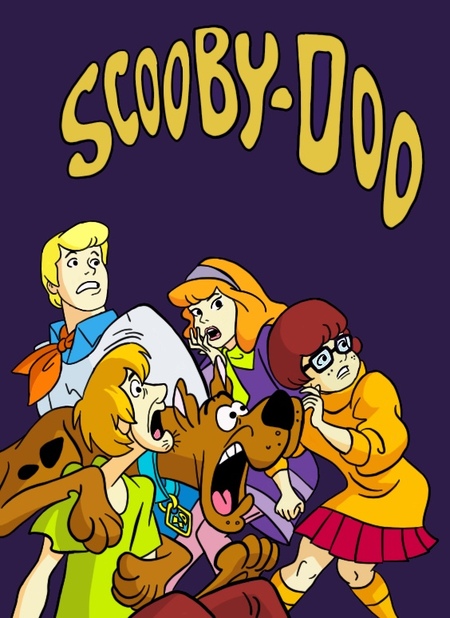
The plot revolves around the dog Scooby-Doo and four teenagers—Fred, Shaggy, Daphne, and Velma. Together, they form the «Mystery Incorporated» and investigate various mysterious occurrences.
Even now, fifty years later, the series continues to live: various remakes, feature films, and spin-offs are being released. Watching this makes one wonder why a formulaic, animationally «budget» series is still relevant and continues to live and evolve?
My visual material for this research consists primarily of clips from the original episodes of the first season of the series «Where’s Scooby-Doo?» That is where the canonical formula of the series was established. However, there will also be clips from later seasons, movies, and various supplements to the cartoon series. For the analysis, I rely on articles about the creators, about the Hanna-Barbera studio, and publications in authoritative journals.
I am drawn to the series as a whole—its context, its visual aesthetic, and its structural characteristics. For my research, the period of 1969–1978 is important: from the first season until the franchise began to become complicated with new characters. During those years, «Scooby-Doo» existed as the perfect product of its time.
In my visual study, I aim to explore and analyze the popularity of this animated series, understand when it emerged and why it took the shape it did, what makes it visually unique, what characteristics the characters possess, and to break down the formula of each episode.
The key question of my research is: why did «Scooby-Doo,» a series with simplified animation, repetitive plots, and «cardboard» characters, become one of the most beloved and long-lasting animated projects?
2. Analysis
To better understand why the series turned out the way it did, one must examine the context. The late 1960s were a period of immense change in American television broadcasting. Parents and social watchdog groups actively protested cartoons they felt promoted violence to children. Cartoons featuring fighting and weapons, which aired during Saturday morning programming, raised particular alarm. Producers sought a formula that would retain the interest of young viewers without giving grounds for complaints.
Dir. Joseph Barber and William Hanna, «Where’s Scooby-Doo?», 1969
A solution was found for the emerging problem: the creators did not entirely remove the conflict from the cartoon, but rather redirected it into an intellectual investigation. Instead of weapons and fights, the heroes are occupied with detective work. The fear of the monster remains, but only to be unmasked in the finale. The series is the result of a unique team. Screenwriters Joe Ruby and Ken Spears developed the concept and wrote the scripts for most of the first season’s episodes. Producers William Hanna and Joseph Barbera, animation veterans and creators of «Tom and Jerry, ” oversaw the production process and overall aesthetic. Animator Hideo Takamoto, who previously worked on Disney projects, created the visual look of the characters. And Fred Silverman, CBS Vice President of Daytime, acted as the ideologue and „client,“ formulating the requirements for the format.
One of the unconventional choices was the use of canned laughter in the original 1969 series. This technique, typical of television sitcoms, was rare in animation. The laugh track guided the viewer on when to laugh, thereby lessening the tension in the «scary» scenes and presenting the show as a comedy rather than a horror.
Directed by Joseph Barbera and William Hanna, «Where’s Scooby-Doo? , ” 1969
Characters
Dir. Joseph Barber and William Hanna, «Where’s Scooby-Doo?», 1969
Each character has a distinct archetype that the audience can instantly recognize: Fred is the team leader; he conceives the trap ideas and is responsible for the main part of the investigation. Visual style: a white shirt, blue pants, and an orange scarf around his neck—his signature look.
Dir. Joseph Barber and William Hanna, «Where’s Scooby-Doo?», 1969
Velma is the brain of the entire team. She finds clues, draws logical conclusions, and delivers the key phrase, «I figured it out!» She is a bit pedantic and cannot stand foolishness, but it is her rational thinking that saves the team every time. Unlike the others, Velma almost never panics. Visual Style: an orange turtleneck sweater, a red skirt, large-lens glasses, and a short haircut.
Directed by Joseph Barbera and William Hanna, «Where’s Scooby-Doo?», 1969
Daphne is someone who constantly falls into traps yet never loses her optimism. She is brave enough to go along with everyone, but rarely offers her own ideas. In the original series, her primary function is to be the object of rescue. Visual style: a purple dress, pink stockings, a purple headband in her hair, and a green scarf. Her wardrobe changes from series to series more often than anyone else on the team. This underscores her status as a «fashionista.» The purple-pink color palette makes her the brightest spot in the frame.
Directed by Joseph Barbera and William Hanna, «Where’s Scooby-Doo? , ” 1969
Shaggy is a perpetually hungry, lazy, and cowardly guy who nevertheless always sticks by Scooby and the gang. He’d much rather be eating sandwiches than searching for ghosts, but friendship and lack of options compel him to go to the scariest places. His panicked scrambles and comedic dialogues with Scooby are the main source of the show’s humor.
Visual Style: a green t-shirt, brown pants, characteristic stubble, and a perpetually slumped posture.
Dir. Joseph Barber and William Hanna, «Where’s Scooby-Doo?», 1969
Scooby-Doo is an anthropomorphic German dog who can talk, loves to eat, and is constantly panicking. He is incredibly timid, yet in critical moments, he always helps his friends. His devotion to Shaggy and the rest of the team is the emotional core of the series.
Dir. Joseph Barber and William Hanna, «Where’s Scooby-Doo?», 1969
Iwao Takamoto intentionally turned the classic German dog into an awkward, yet charming and humorous Scooby-Doo, complete with crooked legs, a hunched back, and a large chin.
Directed by Joseph Barbera and William Hanna, «Where’s Scooby-Doo?», 1969
Though the van is an inanimate object, it functions as a «home on wheels”—a safe space to which the team returns after every investigation. It symbolizes freedom, friendship, and stability within a world of monsters and mysteries. The Scooby-Doo universe would be difficult to imagine without this van. It is the most vibrant and detailed vehicle in the history of Hanna-Barbera animation; its design has barely changed over the decades.
Visual Style
Directed by Joseph Barbera and William Hanna, «Where’s Scooby-Doo?» (1969)