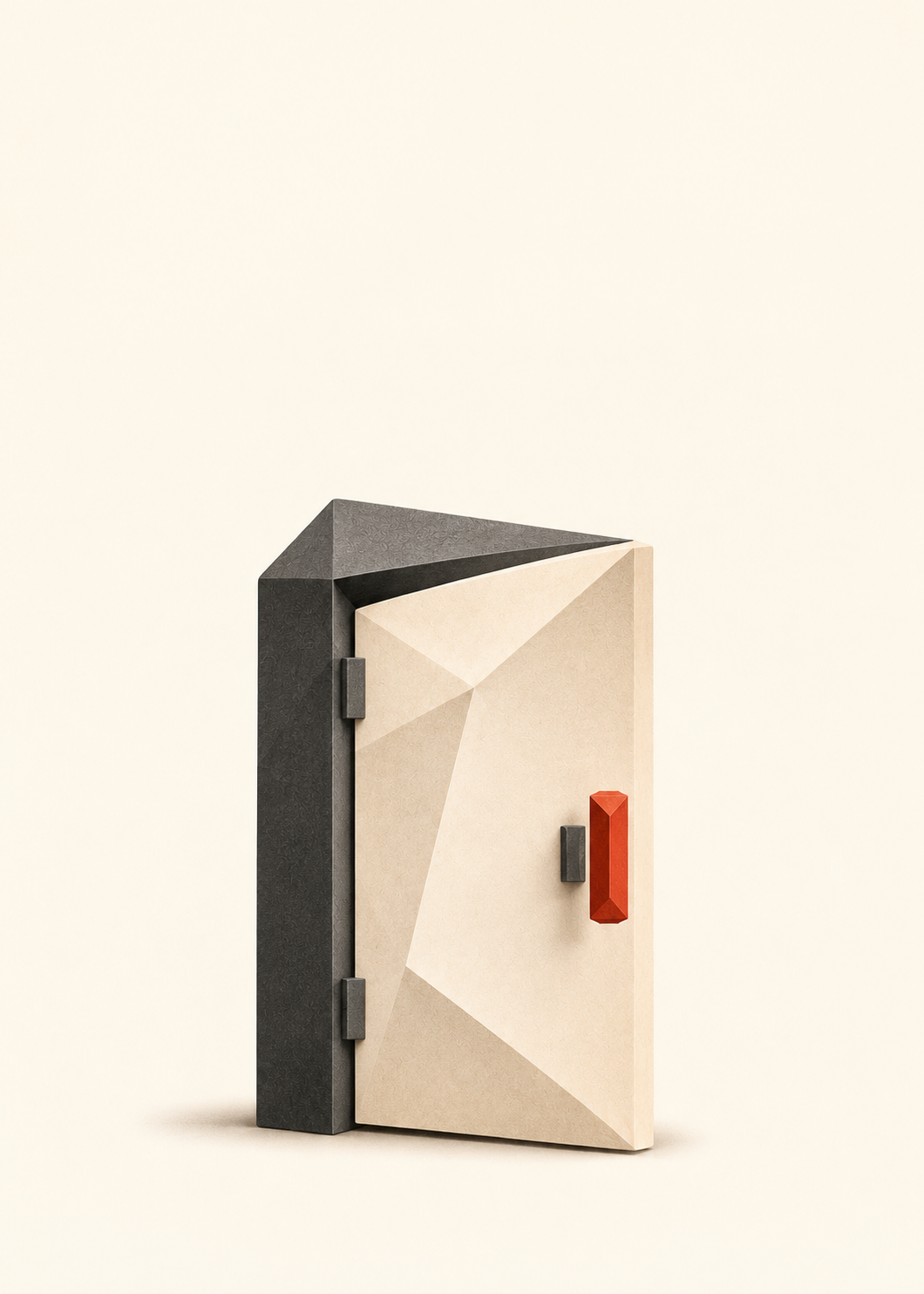
For me, a door begins with the contradiction between the possibility of action and the notification of that action. Don Norman distinguishes between what an object allows a user to do and the cues by which a user recognizes that possibility. A doorknob can participate in both relationships simultaneously: it is grabbed, yet its shape also suggests a specific movement. Therefore, the inscription «pull toward you» interests me as part of the conversation between the design and the user—not as an automatic proof of someone’s inattention.

In his revised edition of «Design of Everyday Things, ” Norman defines affordance as the relationship between the participant’s possibilities and the object. He designates signifier as the perceptible cue that indicates where and how to act. These concepts cannot be interchanged: a physically possible action might remain unclear. The author provides examples such as a door panel, a handle, and glass, which allows one to see through it while simultaneously obstructing passage. For studying a door, this distinction between the action and its discovery is what is useful.From this, I derive a cautious criterion: evaluate a design explanation based on how well it helps predict the necessary action. If a label clarifies an ambiguous form, it does not necessarily mean that a visitor will make a mistake; conversely, the absence of a label does not guarantee clarity either. To move from my interpretation to a statement about a specific door, observations of its use will be required. A description of the form provides a hypothesis about the cue, but it does not replace verification that a person has actually noticed it.

Original illustration created by AI. Conceptual reconstruction, not an image of a specific product.

The U.S. Access Board’s guidelines for operable elements, within the context of ADA standards, consider one-handed operation, the absence of the need for strong gripping, pinch-grasping, or wrist twisting. Examples include lever handles and U-shaped clasps. The document also distinguishes between mandatory provisions and recommendations: while the ability to operate with a closed fist is noted as a beneficial check, it is not listed as a standalone requirement. I am using this source as a specific set of criteria rather than a universal rule for any country.These distinctions alter the order of my analysis. First, one can determine if the movement sequence is understandable; subsequently, one can inquire separately about the effort and motion it requires. A person may correctly understand a handle but still be unable to perform the action. Therefore, I believe the assessment of «intuitive» is insufficient if it fails to account for the physical aspect of the task. This is my own judgment regarding the thoroughness of the review: the guideline itself does not measure the perceptions of visitors to the building we are examining, nor does it allow us to ascribe identical limitations to them.

In the ABA guide, the entrance is considered alongside the approach, the staging, and the maneuvering space. It specifically discusses sequential doors, the placement of the panel, and the adjacent clear space. This illustrates that the interaction doesn’t end at the handle: the visitor must approach, position themselves, open the leaf, and continue along their path. The document’s technical domain refers to specific objects in the American ABA system; the provisions stated there cannot be declared as operative requirements for any entrance without verification.
I propose viewing such an entrance as a sequence of states rather than a static frame. A photograph of a successful handle may not show the visitor’s position during the door’s movement or what remains behind them. Hence, my hypothesis is that some of the issues discussed as «door problems» actually arise from the relationship between several spatial elements. Testing this requires diagrams and observations of passage. The appearance of a single object is insufficient to evaluate the entire route or determine the cause of difficulty.
AI-generated illustration. Conceptual reconstruction, not a depiction of a specific product.
In an article by the Interaction Design Foundation, William Hudson gives his own example: in his neighbor’s apartment, he mistakes the exit door for a closet door because they look nearly identical. This account reflects the author’s personal experience, not the result of a mass study. It interests me because the direction of opening might be clear, but the choice of the door itself is erroneous. The person is already performing a deliberate action, but associates their goal with the wrong element of the surrounding space. By comparing the anecdote with established guidelines, I see the value in sequential recording: what goal the person chose, where they approached from, what they mistook for a cue, and how they continued their path. This kind of recording allows for the discussion of various constraints without reducing them to a single label like «inconvenient door.» It can also help differentiate between a lack of information and an impossibility of action. This is a research method I propose based on documents and the author’s testimony, not a report on an experiment: there are no participants or measurements in this article.
My assessment is that entry clarity should be evaluated alongside action feasibility. A sufficiently clear label can resolve directional confusion, but it does not, by itself, alter the graspability or maneuvering space. Conversely, an accessible mechanism doesn’t automatically communicate how to use it. These are related issues, but the sources allow for differentiation. Therefore, when comparing two doors, I would begin by describing the full scenario, rather than selecting the most concise or aesthetically appealing image.
The next piece of evidence that could change my conclusion about a specific entry is a record of unexpected user behavior—for instance, where they paused and what feature they deemed most important. Even the hypothesis of such a situation does not confirm it actually occurred. Authorial reconstruction is valuable as long as it remains testable: it poses a question to the user rather than explaining their mistake in advance. Thus, the door label becomes a starting point for investigation, not the final word directed at the visitor.