Communication Theory in the Field of Design
In the Middle Ages, when the dominant form of discourse was the quoted word — the Bible — the most important factor was proximity to the source of the «correct» idea… With the spread of dialogue and polyphony, this situation changes significantly. A new communicative space is created by participants who are equal in status and independent of one another (Vladimir Murylev, Theory of Communicationх [1])
Communication theory plays an important role in design and art because it helps explain how visual messages are created, interpreted, and shared.
Rather than viewing communication as a simple transfer of information, contemporary theory understands it as a dynamic process in which meaning emerges through interaction between creators, audiences, and context.
In creative practice, communication begins with encoding and decoding. Designers and artists transform ideas into visual forms using elements such as color, typography, composition, materials, and spatial organization. These elements function as signs that convey meaning. Audiences then decode these signs according to their personal experiences, cultural backgrounds, and expectations. Consequently, the same artwork or design object may be understood differently by different viewers.
Communication theory also highlights the importance of both verbal and non-verbal communication. While text and written explanations provide direct information, visual elements often communicate ideas and emotions beyond language. Form, scale, texture, and symbolism influence how people perceive and understand creative work. Therefore, design can be viewed as a communicative practice that shapes perception and experience.
Another key concept is context. Meaning is not contained solely within an object but is produced through its relationship with the environment and audience.
A visual message displayed in a gallery, on a product package, or on a digital platform may be interpreted differently because each context creates unique conditions for communication. Understanding these conditions allows designers and artists to create more effective and meaningful experiences.
Several traditions of communication theory are particularly relevant to design and art.
The semiotic tradition focuses on signs and symbols, helping explain how visual elements generate meaning. The cybernetic tradition examines communication channels, feedback, and noise. In advertising and branding, for example, excessive marketing messages can create noise that interferes with clear communication. The sociocultural tradition explores how cultural values and social norms shape interpretation, while the rhetorical tradition considers how visual communication can persuade and influence audiences.
Communication theory also emphasizes feedback and participation. In many contemporary projects, audiences are not passive receivers but active participants in meaning-making. Interactive installations and user-centered design approaches encourage dialogue, transforming communication into a collaborative process.
Overall, communication theory serves as both an analytical and practical framework for design and art. By understanding the roles of signs, context, feedback, and audience interpretation, designers and artists can create projects that communicate effectively and foster meaningful connections with their audiences.
Presentation for a General Audience
The idea behind NESTO was born from a very personal observation.
At some point, I started noticing that the plastic tableware we used for children at home was changing over time. It cracked easily, absorbed smells, and no longer felt truly clean, even after washing. I began to study the issue more deeply and learned about microplastic release from plastic products. I realized with fear how much microplastic my younger brother could have been consuming while he was still a baby, simply through everyday products that seemed normal and safe.
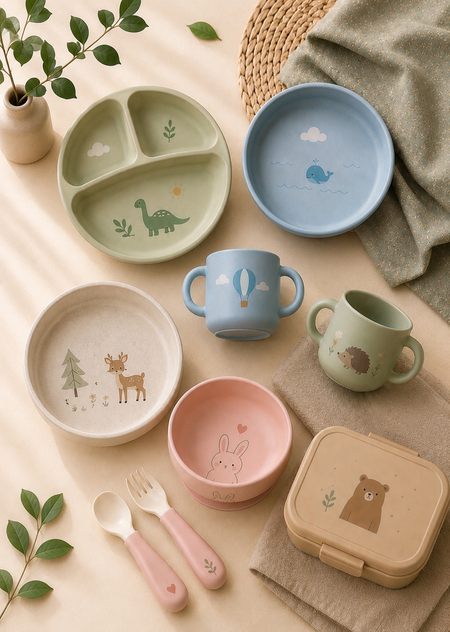
This personal concern became the starting point for NESTO: a brand that offers a safer, softer, and more conscious alternative to standard plastic baby tableware.
BRAND PHILOSOPHY AND VALUES
The philosophy is simple: a baby's first tableware shouldn't ask a parent to choose between convenience and peace of mind. Feeding should feel safe, simple, and worry-free — every single time.
FUNCTIONAL DIMENSION
Medical-grade silicone tableware that handles real life: sterilizing, heating, dropping, biting. No seams, no cracking, no guessing about what's leaching into your baby's food.
SOCIAL DIMENSION
You're not the only parent who's stood at the sink wondering if you're doing this right. NESTO is for parents who ask questions — and a community that shares honest answers.
MENTAL DIMENSION
You don't need to become a materials scientist to keep your child safe. Reading a label should not feel like solving a mystery. NESTO gives parents one less thing to worry about and one more reason to feel calm during everyday feeding.
The target audience of NESTO is modern parents who care about what their child touches, eats from, and uses every day. These parents are looking for baby tableware that is practical, hygienic, durable, and beautiful at the same time. They want products that can handle real daily use: hot food, sterilization, washing, dropping, and teething. They also value aesthetics. They prefer calm colors, soft shapes, and products that look natural in a modern home.
Most importantly, they want peace of mind. NESTO is created for parents who want to feel confident that even the simplest everyday object is made with care.
Presentation for a Professional Audience
The main problem in this segment is that standard baby tableware is still often made from polypropylene, marked as PP or “05”. This material is convenient for mass production: it is inexpensive, lightweight, and resistant to everyday use. However, current scientific data shows that when plastic products are heated, sterilized, or exposed to hot liquids, they may release microplastic and nanoplastic particles.
Therefore, the problem of plastic feeding products is directly connected not only with ecology, but also with everyday childcare practices. Baby tableware regularly comes into contact with hot water, is sterilized, and is used under conditions that may increase particle release.
Analytical graph.
For a professional audience, the choice of material therefore becomes a question of trust, safety, and the manufacturer’s responsibility toward the most vulnerable group of consumers.
THE PROBLEM WITH STANDARD PLASTIC TABLEWARE
The key problem with polypropylene tableware lies in its behavior when heated. In 2020, the study by Li, Shi, Yang et al., Microplastic Release from the Degradation of Polypropylene Feeding Bottles During Infant Formula Preparation, published in Nature Food, examined the release of microplastics from polypropylene baby bottles under the conditions of infant formula preparation.
The Trinity College Dublin study showed that, during sterilization and formula preparation according to WHO recommendations, where water at about 70°C is used, polypropylene baby bottles may release up to 16.2 million microplastic particles per liter of liquid. The study showed that temperature is the main factor increasing particle release: as water temperature rises from 25°C to 95°C, the amount of microplastics increases sharply.
According to the authors’ estimates, infants in different regions of the world may ingest from 14,600 to 4.55 million microplastic particles per day, depending on local feeding practices. Therefore, the problem lies not only in the material itself, but also in its behavior during real everyday use.
Analytical graph.
The issue of plastic contact with baby food is further supported by the Greenpeace International report Tiny Plastics, Big Problem. Laboratory tests of ready-made baby food in soft pouch packaging found microplastics in 100% of the tested samples. The reported range, from 5,000 to 11,000 particles per pouch, shows that the problem concerns not only bottles, but also the broader baby food system, including packaging, storage, and tableware.
This allows the NESTO brand to enter the current agenda of child product safety and offer an alternative to frequent child contact with polypropylene and other plastic materials.
Analytical graph.