Introduction

The LEGO brand is guided by the motto «Only the best is good enough».
Founded in Denmark in 1932 and still a family-owned business, LEGO has grown from a small carpentry workshop into one of the most recognizable toy manufacturers in the world. LEGO provides everything you need for learning, creativity and self-expression. LEGO provides everything needed for learning, creativity, and self-expression. The brand remains committed to Learning through Play, developing 21st-century skills, sustainability, and inclusivity.
Brand values:
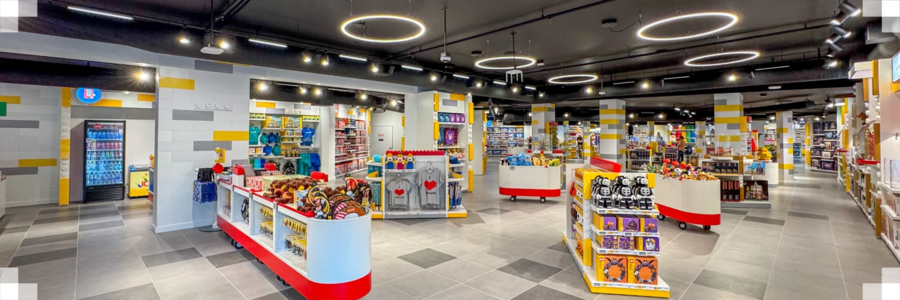
LEGO Shop | LEGOLAND® Florida Resort
Imagination Free play is how children develop their imagination – the foundation for creativity. Curiosity asks WHY and imagines possible explanations. Playfulness asks WHAT IF and imagines how the ordinary becomes extraordinary, fantasy or fiction. Dreaming it is a first step towards doing it.
Creativity Creativity is the ability to come up with ideas that are new, surprising and valuable - and it’s an essential 21st century skill. Systematic creativity is a particular form of creativity that combines logic and reasoning with playfulness and imagination.
Fun Fun is being active together, the thrill of an adventure, the joyful enthusiasm of children and the delight in surprising both yourself and others in what you can do or create. Fun is the happiness we experience when we are fully engaged in something that requires mastery, when our abilities are in balance with the challenge at hand and we are making progress towards a goal.
Learning Learning is about being curious, experimenting and collaborating – expanding our thinking and doing, helping us develop new insights and new skills. We learn through play by putting things together, taking them apart and putting them together in different ways. Building, un-building, rebuilding, thereby creating new things and developing new ways of thinking about ourselves, and the world.
LEGO® Stores
Caring Caring is about our desire to make a positive difference in the lives of children, for our colleagues, our partners, and the world we live in. Doing that little extra, not because we have to – but because it feels right and because we care.
Quality For us quality means the challenge of continuous improvement to provide the best play material, the best for children and their development and the best to our community and partners. From a reputation for manufacturing excellence to becoming trusted by all – we believe in quality that speaks for itself and earns us the recommendation of all.
Target audience
LEGO's core positioning has evolved: from a toy exclusively for children to a global lifestyle brand for all ages. The brand remains committed to Learning through Play, but this hasn't stopped it from also introducing the Adults Welcome strategy. LEGO's target audience is multigenerational and includes four main groups: children aged 5-12 (the core play experience), parents aged 25-45 (the primary payers, driven by nostalgia and educational value), teens and young adults (seeking social interaction through digital projects), and adult fans 18+ (loyal collectors and hobby architects who value status, escapism, and relaxation).
Communication Channels
In the public sphere, LEGO has built one of the most sophisticated ecosystems. On social media, the brand clearly segments its platforms: Facebook for parents, Instagram for young people and adults, and YouTube for animation. LEGO distinguishes itself from other brands by creating protected spaces for children: the LEGO Play App, which is moderated, and the LEGO TV App, which does not have social features. This prevents children from accessing unsafe content.
LEGO's PR strategies include global campaigns with ambassadors. The brand often partners with Hollywood stars, such as Jason Momoa in 2026 for the "Never Stop Playing" initiative. The brand annually publishes a large-scale LEGO Play Well Study, positioning itself as an expert in child development and supporting the UN International Day of Play (June 11, when more than 33,000 LEGO employees worldwide stop working to play with children in their local communities). In addition to celebrity endorsements, the brand also creates strategic partnerships (for example, a global partnership with Crocs). Collaborations also include relationships with media agencies (Publicis One) and television partnerships: in Hong Kong, LEGO has an exclusive agreement with now TV. The brand actively utilizes unconventional content marketing: in May 2026, the LEGO White Noise playlist was released on Spotify and iTunes, consisting of seven tracks created exclusively from the sounds of LEGO bricks. The brand utilizes crowdsourcing through LEGO Ideas, a platform that allows fans to submit their designs, which can be realized as sets. PR strategies also include physical events, such as LEGO House, as well as immersive zones, exhibitions, and creative workshops.
It’s telling that only 0,3% of LEGO products on Walmart use sponsorship promotion—the rest rely on organic visibility—which speaks to the brand’s immense strength and its ability to fit into the modern family lifestyle.
Theoretical Frameworks: Framing Theory and Dialogic Theory
Framing Theory
Framing Theory suggests that media and communication do not simply present information but actively shape how audiences interpret and understand it. Rather than telling people what to think, framing influences how they think about a particular issue, product, or brand by emphasizing certain aspects while downplaying others.
LEGO provides an excellent example of strategic framing, as the company consistently presents its products as tools for creativity, learning, and personal development rather than merely as children's toys. Through its marketing campaigns, social media content, and partnerships, LEGO constructs a specific frame that encourages consumers to associate the brand with imagination, innovation, and educational value.
LEGO Ideas
One of the most prominent frames used by LEGO is the concept of "learning through play". In advertisements and promotional materials, the company rarely focuses on the plastic bricks themselves. Instead, LEGO highlights the cognitive and developmental benefits that children gain from building and creating. Commercials often portray children solving problems, expressing creativity, and developing engineering or storytelling skills while using LEGO products. By emphasizing these positive outcomes, LEGO frames its products as educational tools that contribute to child development. This framing strategy is particularly effective because it appeals not only to children but also to parents, who are more likely to purchase products that provide both entertainment and educational value.
Another important frame is LEGO's emphasis on creativity and limitless imagination. The company frequently communicates the message that there is no single correct way to build with LEGO bricks. Marketing campaigns showcase unique creations, original designs, and personalized projects, encouraging consumers to see LEGO as a platform for self-expression rather than a simple toy. Through this frame, LEGO positions itself as a brand that empowers individuals to think creatively and transform ideas into reality. As a result, consumers associate LEGO with innovation, freedom, and problem-solving abilities, which strengthens the brand's positive image across different age groups.
LEGO Ideas
Furthermore, LEGO uses framing to promote values such as family bonding, inclusivity, and lifelong engagement. Advertisements often depict parents and children building together, presenting LEGO as a tool for meaningful family interaction. At the same time, the company has expanded its communication to include diverse characters, female role models, and products designed for different interests and backgrounds. LEGO also targets adult fans through advanced building sets, demonstrating that creativity and play are not limited to childhood. By framing LEGO as an activity for people of all ages, the brand successfully broadens its audience and reinforces the idea that building and creativity are lifelong experiences.
By emphasizing learning, imagination, family connection, and personal development, LEGO shapes how consumers perceive its products and creates a strong, positive brand identity. This strategic use of framing has contributed significantly to LEGO's global success and its reputation as one of the world's most trusted and innovative brands.
Dialogic Theory

Key authors: Pearson, Kent, and Taylor.
The main idea of the theory, organizations should be willing to interact with the publics in honest and ethical ways in order to create effective organizational public communal channels. Dialogue includes five features: mutuality, propinquity, empathy, risk, and commitment.
Analyzing the LEGO brand from a dialogue theory perspective reveals that the company has a high, but extremely uneven, level of dialogue. LEGO is often cited as an example of a corporation successfully building two-way PR communications with children, parents, adult fans, educators, and others communities. However, a closer look at the five core principles of dialogue—reciprocity, diversity, empathy, risk, and commitment—reveals both strengths and weaknesses. Nevertheless, the company still retains a recognizable brand image as a family-oriented and listening organization.
Mutuality
The supposed events of an inextricable connection between the organization and the public, a rejection of authority and control, and collaboration, where this keen insight is recognized as a worthy one. LEGO has institutionalized reciprocity through the LEGO Ideas platform, where any fan can submit a design, the community votes on the project's fate, and the creator earns income. The company has also created councils for adult fans and focus groups for children, truly creating its own products based on feedback. Official platforms employ moderators who protect participants from ridicule, creating an atmosphere of equal rights to express themselves. However, the current power still rests with LEGO: the company committee can reject even a successfully voted project. Furthermore, language and technological barriers limit some of the community's dialogue, and third-party platforms like Reddit cannot provide a safe environment. However, LEGO has a "stop topic" that it rejects: religion, politics, weapons, and other dangerous topics. Here, LEGO retains the power, but the company does not reject topics without reason. A child or adult can register a project equally. Their voice in the community carries the same weight as that of a company employee, who also creates a safe environment for discussion.
LEGO Ideas