Introduction
Befree is a Russian youth fashion brand founded in 2002. Today it belongs to Melon Fashion Group, the country’s largest fashion retailer, alongside ZARINA, LOVE REPUBLIC, sela and IDOL. The brand operates 268 stores across 83 cities and also sells through five marketplaces. Befree works in the fast-fashion format, with collections updated continuously and up to a hundred new items released each week — a pace that gives the brand a constant reason to engage with its audience.
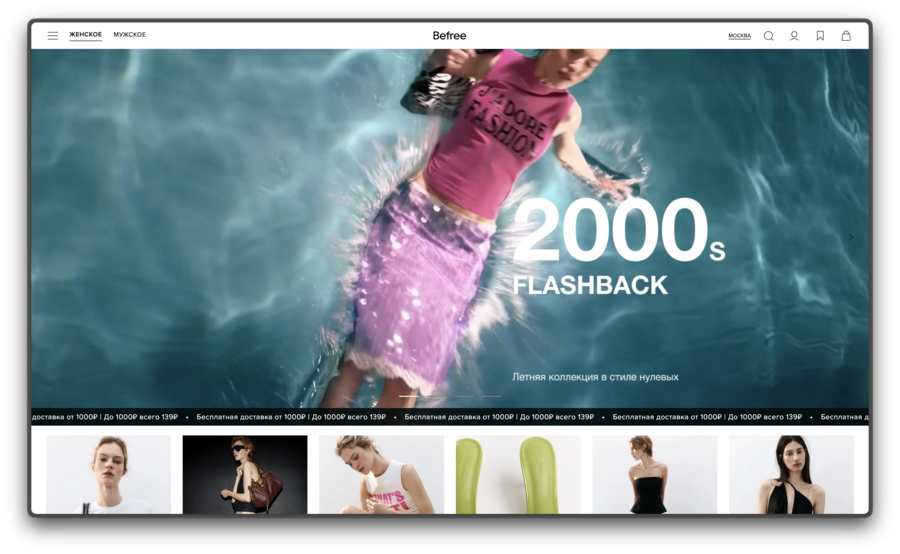
Befree website

The brand’s positioning rests on a simple idea: youth is a matter of mindset, not age. Befree describes itself as a brand «for everyone who loves youth fashion, regardless of age.» The notion of freedom is built into both its name (be free) and its slogan, «It’s always fashionable to be free.» Befree positions itself less as a shop and more as a community that shapes fashion together with its customers.
At its core lies the idea of inclusivity — the belief that everyone is beautiful and unique. The brand is guided by five values: humanity, freedom, intelligence and innovation, creativity, and a focus on the future. Befree deliberately avoids dictating fashion from the top down, preferring instead to co-create it with creative people across Russia.
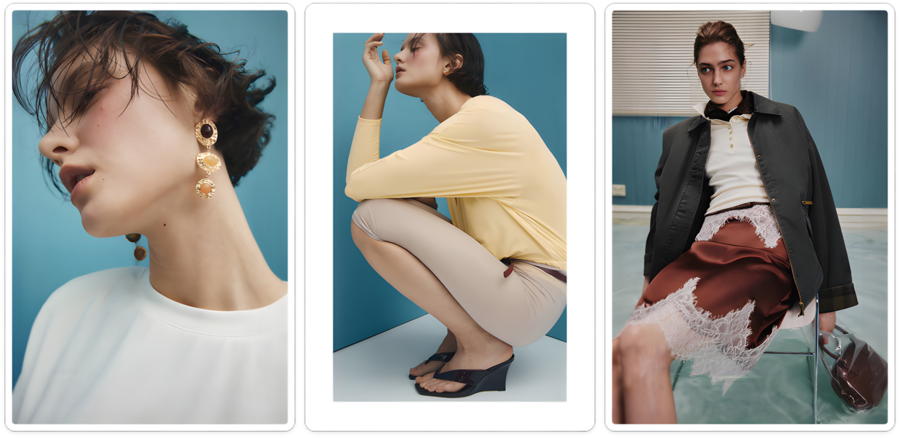
Photos from Befree’s campaign

Its audience consists of the young and the young at heart: digitally native consumers for whom clothing is a means of self-expression. Originally a women’s brand, befree is now expanding its menswear line as well. Yet the audience is defined by behaviour more than by age or gender: for this audience, participation matters more than the purchase itself
Befree Co: Create projects
Participation is therefore embedded directly into Befree’s business model. The brand has grown a community known as #BefreeCommunity, and since 2021 it has run the Befree Co: Create project, releasing at least one collection each month in collaboration with artists, influencers, charitable foundations and its own followers. «Creating fashion together» is a genuine working process for Befree, supported by regular monthly releases. The following sections examine the theories behind this approach: the active audience as described by Uses & Gratifications theory, and two-way symmetrical communication as described by Dialogic Theory.
Communication Channels
Befree’s communication is organised as a single, connected ecosystem of channels. The brand maintains its own digital platforms alongside several social networks, and it drives promotion through influencer marketing and large-scale PR campaigns. The defining feature of Befree’s whole public field is the direction of communication: it does not flow from the top down, but works as a dialogue with the audience and relies heavily on content created by the subscribers themselves.
The brand runs several platforms, and they are all interconnected: the website befree.ru, a mobile app, a VKontakte community, a brand channel on Telegram, a dedicated Telegram bot for order enquiries, and a channel on the new social network MAX. The channel description already states the brand’s main guidelines: it calls itself «a Russian brand of women’s and men’s clothing» whose promoted values are «accessibility and inclusivity,» and it adds the hashtag #ВсегдаМодноБытьСвободным («It’s always fashionable to be free»). How close this communication is can be seen from the statistics of a single community channel: 14,012 photos, 995 videos, 2,811 links, 217 polls, and 51 voice messages. The polls are especially telling, since they show that the brand does not only publish content but also gathers responses from its audience.
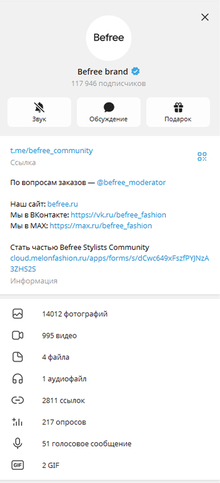
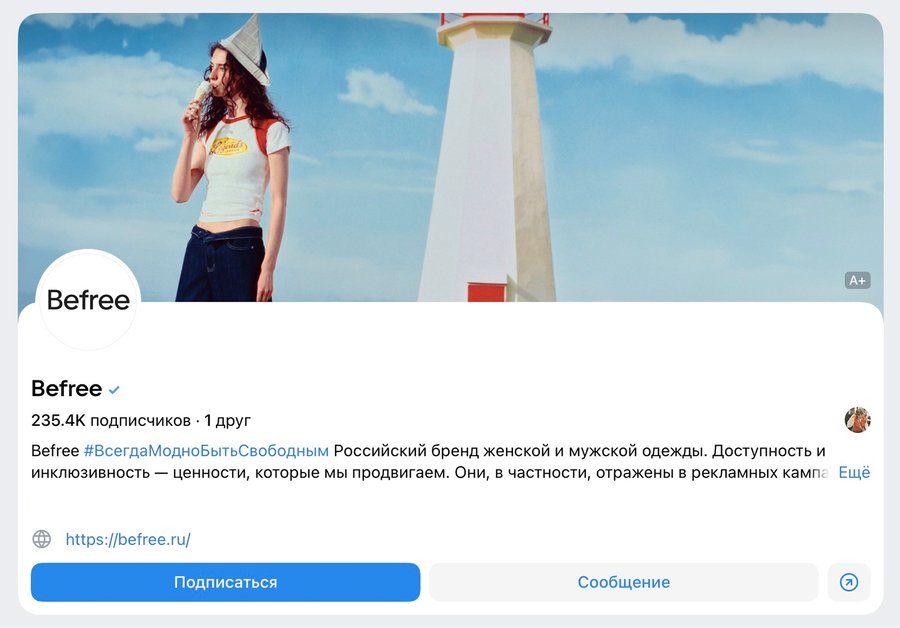
Screenshots of Befree’s official Telegram account and VK group
Befree Store’s mobile app
Befree responds constantly in the comments: it thanks users for their feedback, explains the terms of promotions, announces contest results (for example, «Co: Create HUB TEKST: DROP»), and speaks with subscribers as equals, not as a distant brand. The discussions make it clear that a real person stands behind the account and reacts to specific comments. Because of this, the feed functions as a space for dialogue and not as a one-way showcase.
Brand interacts with the audience
A separate strand is the #BEFREECOMMUNITY rubric and the Befree Stylists Community (for example, a post with Lisa Barashek). Here the brand photographs real people from its audience, including bloggers, creatives, and ordinary subscribers, instead of professional «brand-face» models, and it tells their personal stories: a shoot with a hero at home, a video diary from a trip, a story about a «grandfather’s T-shirt.» The subscriber becomes a hero of the brand and a co-author of its content. In this way Befree gives people a platform for self-expression and creates the feeling that they belong to a shared community.
Befree builds its paid promotion on influencer marketing through the Perfluence platform, using a CPA model. The brand works with a large number of small bloggers and pays for results, that is, for sales instead of reach. This fits the general logic of Befree: anyone can feel part of the brand and act as a micro-influencer without having to be popular.
Befree works with small bloggers
Befree’s flagship PR campaign is the value-driven project «It’s Always Fashionable to Be Free.» At its centre is a video manifesto featuring eleven different characters: a plus-size model, a person with a hearing impairment, a dancer, and several brand founders. The video is built around freedom of choice and diversity, not around specific clothes. The campaign has its own microsite, a video on YouTube, and a manifesto book produced together with Seans magazine, with all proceeds from sales going to the «Anton Tut Ryadom» («Anton’s Right Here») foundation. In effect, the brand promotes its values (freedom, inclusivity, and charity) more than any single product, and it draws both the media and the audience into the message.
Befree «It’s Always Fashionable to Be Free»
Theoretical framework
To analyse Befree’s communication in scientific terms, we use two theories from the course, each answering a different question. Uses & Gratifications theory explains why the audience is drawn to the brand’s content and what it gains from it. Dialogic Theory explains how Befree builds its relationship with that audience and why its communication can be called two-way. Together they describe both sides of the same process: an active audience, and a brand that talks with it.

Uses & Gratifications theory was proposed by Blumler and McQuail in the 1970s as a response to earlier media-effects research. Its central question is not what media do to people but what people do with media, and for what purpose. The audience is active: it selects content to satisfy its own needs, and media compete with other resources to meet them. These needs are mapped onto Maslow’s hierarchy, from belonging to self-actualisation, whose highest point is reached when a person creates content, shares it, and gains the approval of a community. Blumler and McQuail identified four types of use: diversion (escape from routine), personal relationships, personal identity, and surveillance (curiosity about other people’s lives). For our purposes this is a working tool, since it lets us show which needs Befree meets through the #BefreeCommunity rubric and user-generated content.
Maslow’s hierarchy

To assess two-way communication specifically, we first recall Grunig and Hunt’s four models of public relations, which range from one-way broadcasting (press agentry and public information) to two-way models. Most fashion brands work on the two-way asymmetrical model: they study their audience in order to influence it more effectively, while the organisation itself does not change. The highest model, two-way symmetrical, is built on research, mutual respect, and the organisation’s willingness to change together with its publics. Befree leans towards this model, and the communication it describes is the subject of Dialogic Theory.
Dialogic Theory was developed by Pearson, Kent, and Taylor, and is regarded as the most ethical theory in public relations. Here dialogue means an honest exchange of opinions with respect for the other party, and it rests on five features: mutuality, propinquity, empathy, risk, and commitment. Online, this dialogue works through the dialogic loop: comments, polls, answers to questions, and feedback. These five features become the criteria by which we assess Befree’s exchanges with its subscribers.
Analysis

The theory explains what people do with media and for what purpose. In this case, the audience is active and chooses content for specific needs. Below, we show how befree covers four types of use and reaches self-actualization according to Maslow.
Diversion The befree feed is constantly updated with lookbooks, styling collections, and video diaries. In addition, the brand creates «youthful content» in the form of reels to reduce the distance between the audience and the brand. According to Blumler and McQuail, diversion means escaping the monotony of everyday life. The «Escape to Befree» recycling quest is based on the same principle: it turns the environmental theme into a game and keeps the audience engaged for longer than usual scrolling.
Personal identity Instead of professional models, the #BefreeCommunity and Befree Stylists Community sections feature regular subscribers, bloggers, and artists. The function of personal identity is that people see themselves through the stories of others, allowing subscribers to recognize themselves in the post’s hero based on their age, style, or experience and use the content as a mirror of their own identity.
#BEFREECOMMUNITY Zhenya Kalinkin and Katya Kischuk