Navigation
— Concept — Painting of the 16th–19th Centuries — Art of the First Half of the 20th Century — Art of the Second Half of the 20th Century–Early 21st Century — Conclusion — Bibliography — List of Image Sources
CONCEPT
This visual study examines the evolution of the symbolism of mirrors and reflective surfaces in art, from the sixteenth century through contemporary artistic practices.
Today, mirrors surround us from every angle—the glass facades of buildings, interior furnishings, and smartphone screens. The mirror has become an indispensable, almost unnoticed part of daily life. However, I am less interested in the object’s direct function and more in its psychological and social weight. Initially, the mirror was a luxury item unattainable to most; its inherent properties, size, and clarity of reflection dictated not only an individual’s self-perception but also their social standing. In art, reflective surfaces served not only as elements that illusory altered composition but also as carriers of hidden meanings.
My reflections are rooted in ideas from psychoanalysis and the philosophy of limitation. Jacques Lacan described the concept of the «mirror stage, ” which explains that we perceive a more complete, perfect image of ourselves in the mirror than we feel internally. This generates an internal conflict between the image constructed in the mind and reality, leading to a need for constant self-monitoring.
Michel Foucault’s concept of the „Panopticon“ complements this thought—the constant, even imagined, surveillance compels an individual to severely discipline themselves. Interaction with a mirror has a similar effect. When we are within the field of our own reflection, we are compelled to adhere to a certain ideal even when no one is watching us.
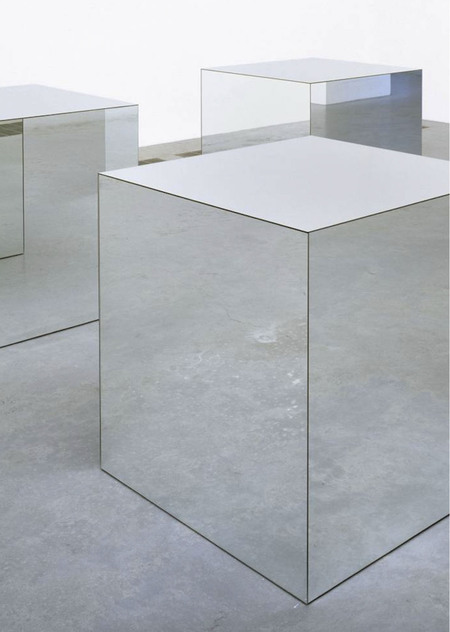
Based on this theory, we can trace the evolution of how reflective surfaces have been used to convey the idea of limitation across different artistic eras. In classical painting of the seventeenth–nineteenth centuries, the mirror functions as a strict social overseer directly within the canvas. During the early twentieth-century Modernist era, the mirror transforms into a metaphor for the psychological cell. In contemporary art, the mirror transitions from a flat image to a three-dimensional form; it becomes a tangible, volumetric object. Self-control and limitations move beyond the figures on the canvases and are transferred directly to the viewer, involving them in the work’s space.
Within this research, the conventional perception of the mirror is dismantled; the instrument used to expand the visible boundaries, change space, and alter meaning acts as a rigid physical and psychological threshold.
Key research question: How did the mirror travel from an illusory space on the canvas plane to an aggressive physical object that restricts and disciplines the viewer’s body?
Research Hypothesis: The presence of mirrors in art was originally a way to establish boundaries. In classical painting, it constrained characters within the confines of social etiquette. In contemporary art, it has become a tangible physical barrier that forces the viewer into constant self-scrutiny.
PAINTING OF THE 16TH–19TH CENTURIES
In classical painting from the 16th to the 19th centuries, mirrors were utilized by artists as a tool to establish boundaries, confine characters, or necessitate a moral or social judgment of an action. The mirror functions as an unseen witness, reflecting the viewpoint of a society governed by strict regulations. In portraits and intimate, domestic scenes, the presence of a mirror suggests that a person is constantly monitoring their own physical presence; even in the rendering of figures, a calibrated precision and an unconscious engagement with reflection can be traced. The painting’s protagonist finds themselves trapped between the canvas and the mirror—between the gaze of an external observer and constant, internal self-regulation.
Venus with a Mirror (1555) Titian
Venus with a Mirror (c. 1647–1651) Diego Velázquez
Music Lesson (1662–1665) Johannes Vermeer
In the canvases of Titian, Velázquez, and Vermeer, the cell functions as a visual trap; its placement strips the heroines of privacy. Facing the viewer, the reflection transforms into an element of surveillance that disciplines the body’s posture and directs the observer’s gaze.
Portrait of Madame Muatessée (1856) Jean Auguste Dominique Ingres

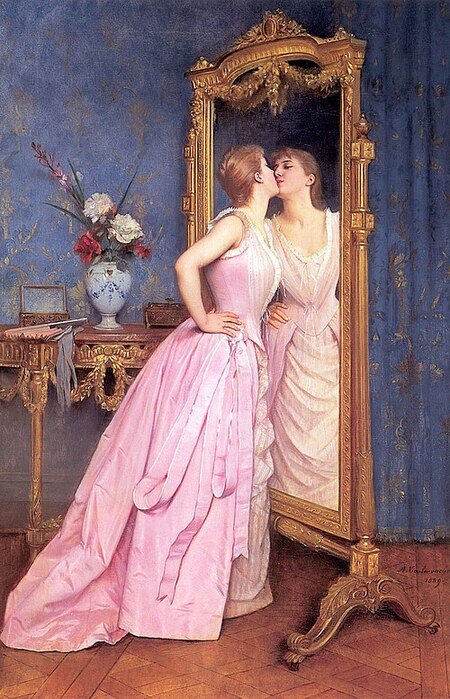
Vanity (1870) Auguste Toulouse
Madame Jeanotte Before a Mirror (1875) Edgar Degas
Psyche (1876) Bertha Morizo
Enghr, Tulmus, DeGa, and Morizo present the mirror as a tool of social normalization of the female body, through which the heroine creates her public image to gain the required social status.
Bar in «Folies Bergère» (1882) Edgar Manet
Mirror (1900) William Orpen
In the works of Manet and Orphen, the mirror optically entraps the heroine in space, creating an inescapable sense of being watched from all sides.

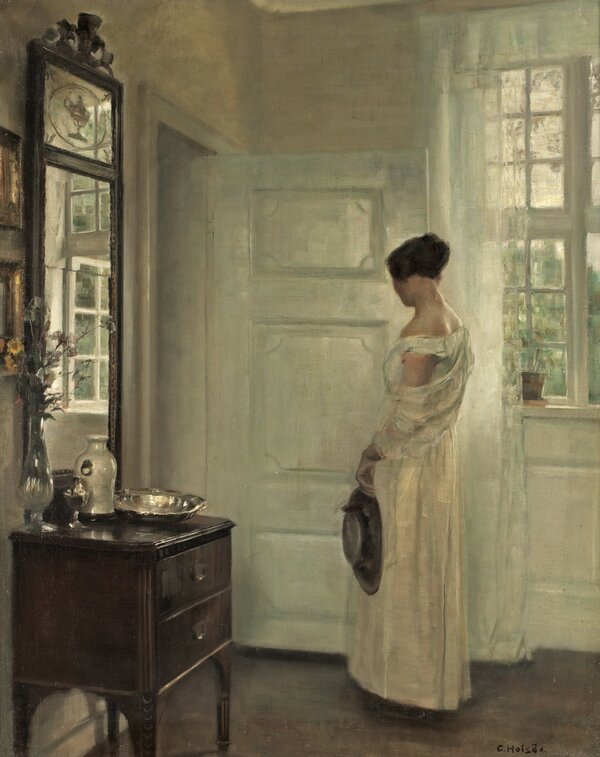
Interior with a woman at a toilet (circa 1900) Carl Wilhelm Holso
Through the rigorous geometry of the room and the massive mirror, Halsö creates a sense of enclosure; leaving the room feels impossible, even with the door open.
ART OF THE FIRST HALF OF THE 20TH CENTURY
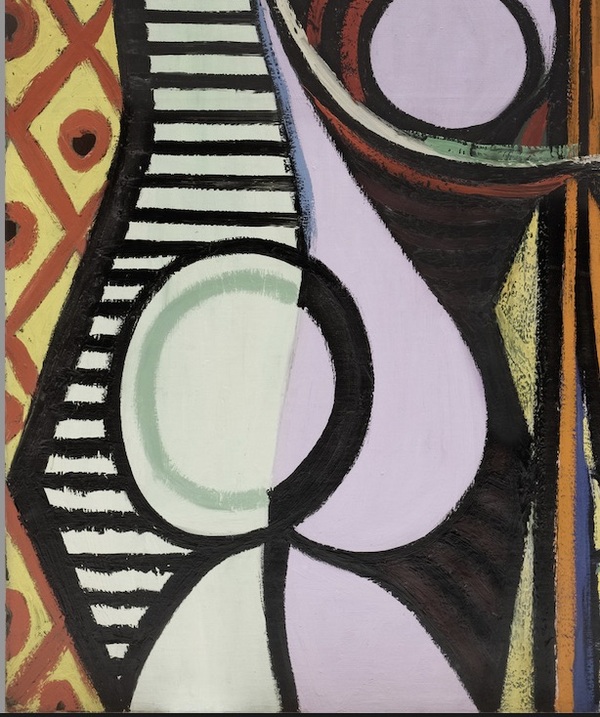
Art in the 20th century rejects the illusion of objectivity. The mirror embodies the idea of a psychological trap; Surrealist and Expressionist artists use reflection to portray the fragmented self. During the Modernist era, it is not the body that is framed, but the mind—the unified perception of the image becomes distorted, leading to anxiety and a sense of isolation.
Girl Before a Mirror (1932) Pablo Picasso