Concept
Contrary to common belief, the classical tradition of European art was neither singular nor unquestionably dominant for architects, sculptors, and other artists. Alongside it existed an alternative branch of classical development—the grotesque. The very word «grotesque» simultaneously captures the essence of this phenomenon—exaggerated, imperfect, fantastic, bizarre—and refers to the location of the first famous discovery that inspired Renaissance masters: the underground chambers (from Italian grotta—cave) of Nero’s Golden House. Engaging with the grotesque allows us to examine classicism not only through the prism of exemplary structures with clear and «correct» forms, but also through its own deviation—the self-irony of the system. Therefore, this theme remains relevant today: a similar trend is discernible in modern times. Tired of everything ideal, artists seek out new, diverse, «imperfect» forms to impress the viewer. It is important, however, to understand that this attraction to the grotesque is not an invention of only our time. It has existed in various forms and degrees throughout the entire history of European art. Masters of antiquity, the Renaissance, and the Modern period employed similar techniques for different purposes.
Thus, a research question arises: how did the grotesque, born within the classical current, become a distinct form of artistic thought, and can it be considered an «alternative classicism»? My hypothesis is that the grotesque is not an external opposition to classicism, but rather an intrinsic part of it—a feature utilized by artists at different times for different purposes. The objective of this research will be to examine several historical periods and analyze the significance attributed to grotesque motifs within each of them.
Based on the research objective, the principle of epochal rubrication will be used. The first chapter will be dedicated to the origins and use of grotesques in antiquity. It plans to identify the main characteristics of the grotesque and how it differs from the features of the conventional classical tradition. The second chapter will examine the period following antiquity—Early Christian art and its interaction with other cultural traditions. The goal of this section is to show that the traits of grotesque art manifested in other cultures in some way and found a place within Christian narratives. The third chapter will cover the Renaissance period and the rediscovery of the grotesque. The main focus will be on Raphael and his students, with an emphasis on how they reinterpreted the ancient grotesque tradition. The fourth chapter will be devoted to the Early Modern period and how the grotesque gradually gained popularity and acquired new meanings. The work will conclude with a summary of findings.
Visual research will be based on photographs from open sources. To illustrate the theory, we will use images of individual details from the frescoes of the Domus Aurea and other monuments of Roman mural painting, Raphael’s loggia grotesques, Baroque interiors, and some other works of European art. By selecting these specific materials, the project plans to reveal patterns and the evolving function of the grotesque—from antiquity to modernity. Theoretical support will be drawn from existing works on the grotesque, as well as peer-reviewed studies dedicated to grotesque ornamentation.
Fragment of the painting in Nero’s Golden House, 64–68 AD.
Antiquity


Fragment of the fresco in Nero’s Golden House, 64–68 AD.
Fragment of the fresco in Nero’s Golden House, 64–68 AD.
Fragments of the frescoes in Nero’s Golden House show how, as early as antiquity, grotesque or the so-called third Pompeian style—characterized by ornamentation—emerges within the classical tradition. Delicate architectural elements here are intertwined with fantastic figures and botanical motifs, forming an unstable, «suspended» space. Such hybrid compositions disrupt rational order yet remain part of prestigious palatial decor.


Exhibition From Pompeii to Southern Gaul: The Fourth Pompeian Style, Musée Saint-Raymond, 62–79 AD
The Fourth Pompeian style of mural painting integrates elements of architectural illusion, decorative panels, and small-scale fantastic motifs. It is characterized by complex, multi-tiered compositions where «broken» architectural structures combine with small insets—mythological scenes, figures, mascarons, and botanical ornamentation. It is within this style that grotesque tendencies are most pronounced: space becomes unstable and fragmented, and the classical order language transforms into a play where the real and the imaginary constantly intersect.


Herculaneum, Mosaic of Neptune and Amphitrite, 1st century BC // Herculaneum, Fresco fragment, 1st century BC
House with an Elk, Herculanum, Fragment of a Pediment, 41–54 AD
On the frescoes and mosaics of Herculaneum, small mythological scenes are the centerpiece, enveloped by a delicate architectural framework, mascarons, and ornamentation. The contrast between the «serious» mythological image and the dynamic, fantastical frame underscores the grotesque nature of the decoration.


Capital of the Temple of Augustus from Pozzuoli, 2nd century BCE // James Stuart and Nicholas Revett, The Antiquities of Athens, 3rd edition, reconstruction of the capital of the Temple of Augustus from Pozzuoli, 1794


Fragment of the frescoes in Nero’s Golden House, 64–68 AD.
This is especially noticeable when comparing the earlier structure—the Temple of Augustus—with Nero’s Golden House: the ornamental motifs grow more «grotesque» and whimsical over time. The figures become more fantastic, the connections between elements less logical, and the decorative layer increasingly detaches from the familiar, strict classical structure.
The material examined suggests that the origins of the grotesque in European art trace back to the ancient decorative tradition. Even in the frescoes of Nero’s Golden House and the later Pompeian and Herculaneum interiors, we see characteristics of the grotesque: hybrid creatures, mascarons, fantastical architectural constructions hanging on thin threads, limbs and bodies blending into vegetal motifs, as well as the contrast between serious mythological scenes at the center and playful, fantastic ornamentation on the edges.
Early Christianity and the Middle Ages
Mural paintings, catacombs on the Appian Way in Rome, 2nd century AD.
Ceiling Mural, Crypt of Pretextata, 2nd Century
Mural painting with a floral bouquet and doves, the catacombs on the Appian Way in Rome, 3rd century.
In the early Christian tradition, grotesque motifs do not disappear; rather, they are recontextualized within a new theological framework. Fantastical creatures, mascarons, bizarrely interwoven vegetal tendrils, and hybrid ornaments appear in wall frescoes and decorative friezes alongside biblical scenes. These elements inherit the decorative freedom of antiquity but now serve different functions: they emphasize the victory of the sacred over chaos, introduce themes of the struggle between good and evil, or act as visual warnings and allegories. Thus, the grotesque gradually transitions from the realm of «playful» antique luxury into the space of Christian iconography, retaining its fantastical nature while being imbued with new meaning.
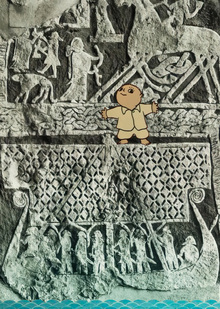
Fragment of a sled from Oseberg, Norway, 9th century, The Viking Ship Museum
Church Portal, Urnes, Norway, 11th Century
The animal style in Viking art provides another crucial example of grotesque thinking emerging outside of the classical tradition itself. In the ornamentation of northern peoples, animal bodies are stretched, interwoven, and fragmented, transforming into a complex knot of limbs, jaws, and tails. The figures lose anatomical «correctness, ” but they gain the rhythm and tension of the ornament. This treatment of the body—its deliberate deformation, its transformation into an almost abstract pattern—echoes the classical and later grotesque: here, too, hybridity, dynamism, and the rejection of a stable, „normal“ form are valued for expressive power and the symbolic force of the image.
Psalter of Latrell, England, c. 1325–1340
Grotesques in medieval manuscripts can be viewed as a specific form of graphic grotesque. Strange hybrid creatures—beast-men, fantastic birds, scenes of everyday humor, and outright absurdity—appear in the margins and at the bottom of pages, alongside serious biblical or liturgical texts. These marginal images disrupt the solemnity of the main content, introducing an element of play, humor, and sometimes even subtle critique into the book’s «official» space. Thus, much like ancient and Christian ornamentation, the grotesque is built not outside but within the sacred visual system, functioning to highlight its internal tension and self-irony.
Analysis of medieval art demonstrates that grotesque motifs did not simply disappear; rather, they evolved, organically integrating into a new, Christian worldview. In early Christian art, the classical ornamental freedom was subordinated to theological objectives, imbued with allegorical meaning. The Viking animal style, which emerged on the periphery of classical tradition, revealed the universality of grotesque thought, where deformation and hybridity served the aims of ornamental expressiveness and symbolic power. Finally, the marginal drôlerie grotesque incorporated elements of play, absurdity, and self-irony directly into the sacred space of the manuscript. Thus, in the Medieval era, the grotesque firmly established itself as a universal artistic language—one capable of existing within the official system, undermining its monolithicity from within while enriching it with complex semantic nuances.
Renaissance